
Key Takeaways:
- The Relevance Gap is the disconnect between your content and your customers’ actual information needs
- AI operates in semantic space, not keyword space—it retrieves passages that answer questions, not pages that match keywords
- AI favors measurable, comparable attributes over vague claims—it needs facts it can reason with, not opinions it has to trust
- Semantic density means giving AI concrete information to connect to specific customer conversations
- Your entire digital footprint trains AI’s understanding of your brand
For years, keyword optimization was the center of gravity for every SEO campaign. You’d pull keyword data, sprinkle those phrases throughout your title tags and H1s, and watch the rankings climb. Your reports looked good. Your boss was happy.
Those days are over.
AI Thinks in Semantic Space, Not Keyword Space
Search engines used to need keyword repetition as a shortcut for understanding what a page was about. Today’s AI systems work differently. Every concept an LLM knows lives in a high-dimensional space divorced from English. When someone asks about finding an auto body shop, AI activates an intermediate representation containing “car,” “broken,” and “repair”—concepts floating in latent space, not tied to specific words.
This means AI doesn’t match keywords. It retrieves passages, not whole pages, that are semantically relevant to the question being asked. A page can hit every keyword-density target and still fail to answer the actual question, because “relevant” and “keyword-matched” were never quite the same thing.
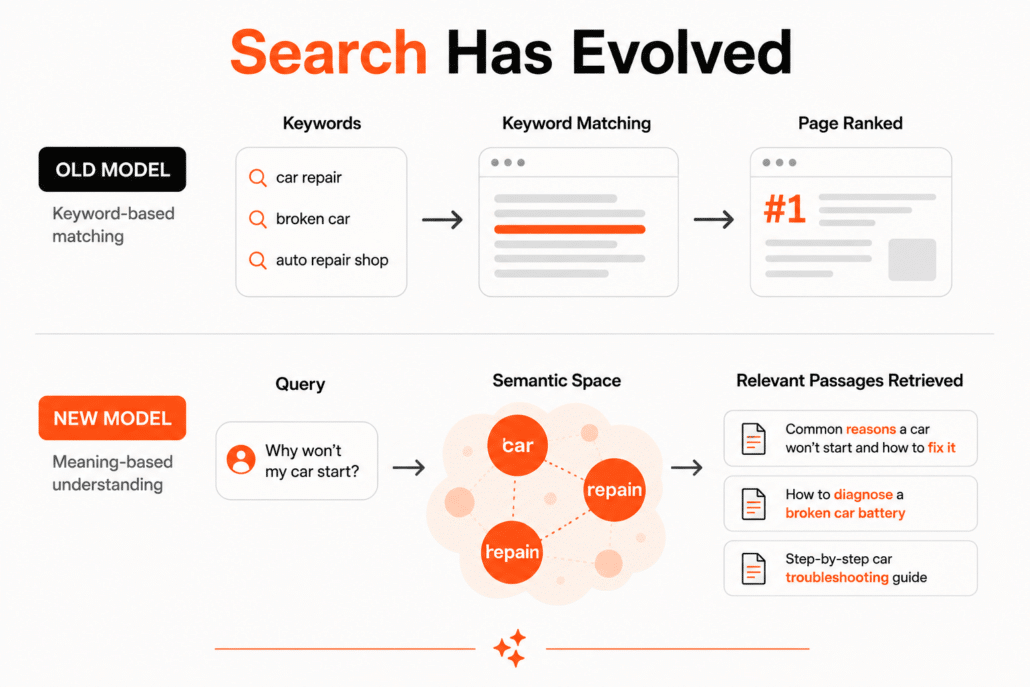
LLMs don’t care how many times your target keyword appears in your H2s. They care whether your content actually explains what the person asking needs to know. AI will skip past a keyword-optimized page to cite the one that does.
The Relevance Gap: A Definition
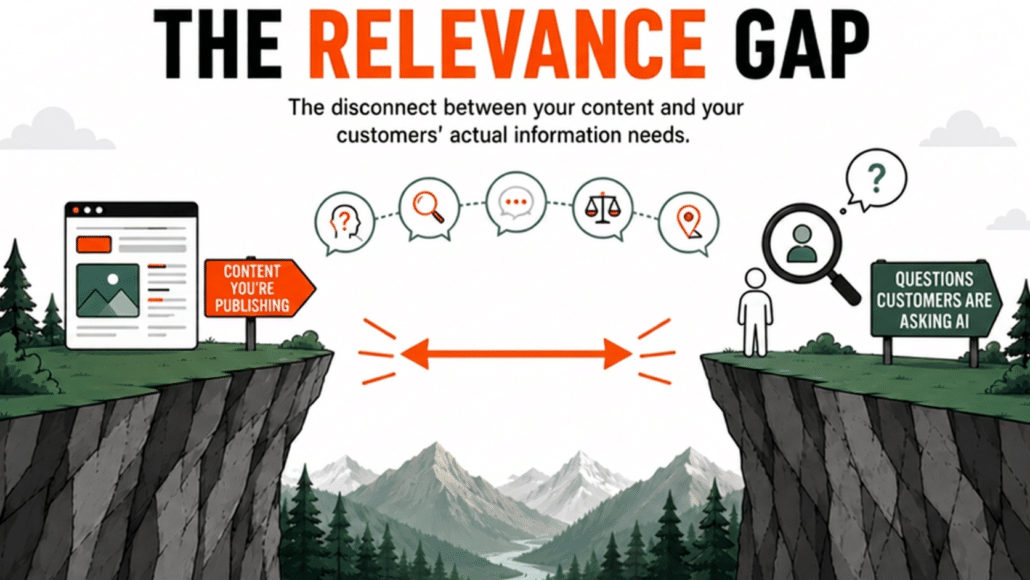
The Relevance Gap is the disconnect between your content and your customers’ actual information needs.
When buyers ask AI about their specific concerns, AI selects and summarizes passages that directly answer those questions. If your site focuses on topics your customers don’t ask about, or frames information in ways that don’t match their concerns, AI has little reason to surface your content. You lose customers not because your product falls short, but because your content doesn’t align with the conversations buyers are having inside AI tools.
When Keyword Data Misleads You
We worked with a client selling incontinence supplies. They’d built their content strategy the traditional way: pull keyword data, see what people search for, write around those terms. They had content on medical causes, emotional support, leakage and fit issues.
What they didn’t have was product comparisons or anything that helped someone actually choose one product over another. That gap wasn’t visible in their keyword data. It only became clear when we started reading Reddit threads, listening to sales call recordings, and talking to customers directly.
The keyword tool never surfaced comparison content because nobody types “compare incontinence products” into Google the way they’ll ask AI that core query in a dozen different ways.
When Rankings Don’t Equal AI Recommendations
We saw the same pattern with an HR platform client. Deep library of educational content, solution pages ranking well for bottom-of-funnel keywords. It looked healthy by every traditional metric.
But when we checked AI visibility, the brand was mentioned in response to informational and branded questions. It rarely appeared when AI tools were asked to recommend a product.
The solution pages weren’t representing the specific needs people were typing into ChatGPT or Perplexity. A page can win a keyword ranking without ever winning the conversation.
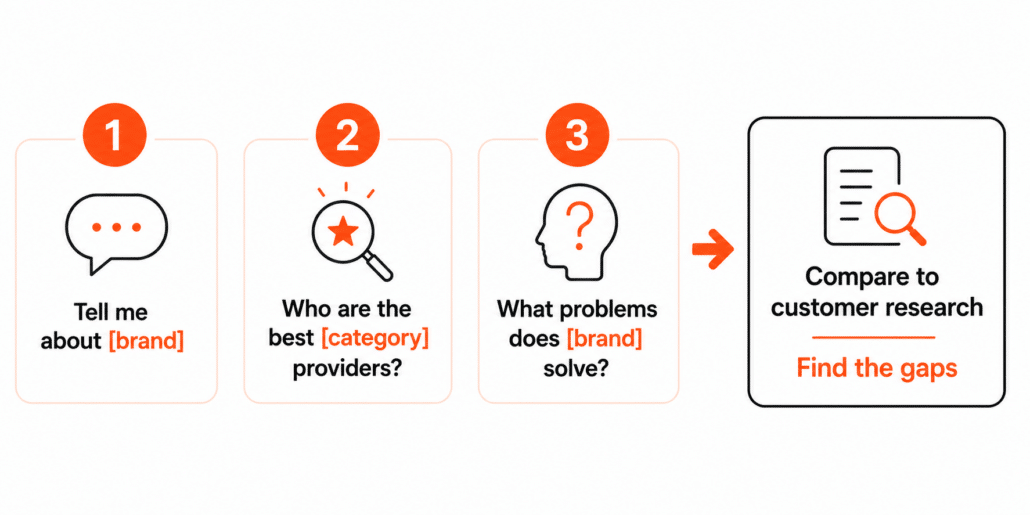
Run this three-prompt sequence through the AI tools your customers use:
- Tell me about [brand]
- Who are the best [service category] providers?
- What problems does [brand] solve?
Compare those answers against what you know from customer conversations and sales calls. Wherever those two sources disagree is your relevance gap.
The Spec Sheet vs. The Slogan
Here’s the core problem: AI needs facts it can reason with, not claims it has to take on faith. Handing AI a slogan like “the best running shoe on the market” is like handing an insurance claims adjuster your opinion on the value of your damaged property instead of actual receipts. AI has nothing to process, so it moves on to the next file. Handing AI a spec—”8mm heel-to-toe drop, GuideRails support, tested for overpronation”—is like handing the adjuster a receipt with the purchase price of the item. It doesn’t need to trust your brand’s messaging. It can act on the facts.
Research on AI-mediated brand recommendations found that AI systems favor brands whose value can be expressed as measurable, comparable attributes backed by credible evidence, over brands that rely on vague claims or emotional positioning alone. A page that says “premium quality” gives AI nothing to connect to a customer’s specific need. A page that says “1,000-cycle durability, ISO-certified” gives it a fact it can reason with.
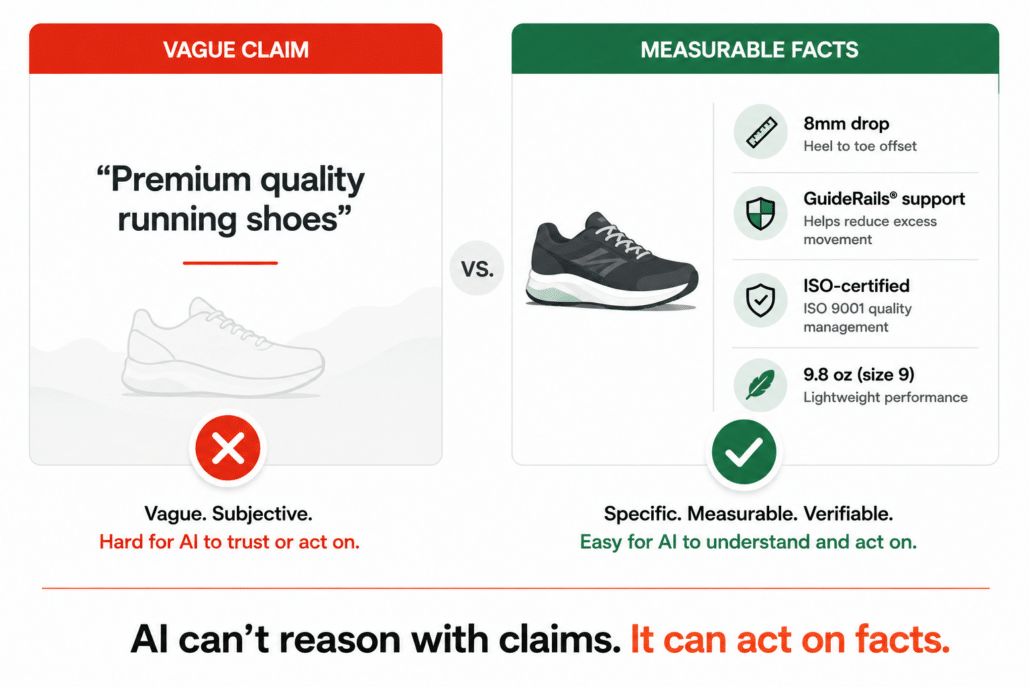
This reframes what “semantic density” actually means. It’s not just about packing more words in. It’s about giving AI concrete, comparable information to work with.
Low semantic density: “These running shoes are made for runners who want comfortable shoes that help them run better during training and everyday workouts.”
AI picks up: shoes, runners, comfort, training. Not much to work with when comparing to competing products.
High semantic density: “These running shoes are made for marathoners who need cushioned midsoles, breathable uppers, neutral support, heel lock, and durable road traction.”
Now AI knows the audience is marathoners specifically, the use case is long-distance road running, and there’s a list of concrete features to match against a specific customer conversation.
We’ve seen this play out for e-commerce clients—denser product descriptions with more attributes increased citations by 20 to 30%.
Your Entire Digital Footprint Matters
AI pulls from your entire digital footprint when forming an opinion about your brand: your website, product pages, customer reviews, social media, even what competitors say about you.
You don’t control all of it. But AI learns from reviews, social mentions, and forum discussions across the web. If your customer reviews, case studies, and product pages all communicate the same specific, accurate attributes, AI has a much easier time matching your brand to the right conversation.
One caution: AI systems are trained with what Dale calls a “bullshit detector”—they filter spam and inauthentic content. Content generated robotically, without human vibrancy, gets filtered out. Generic, over-optimized content fails because AI actively detects inauthenticity.
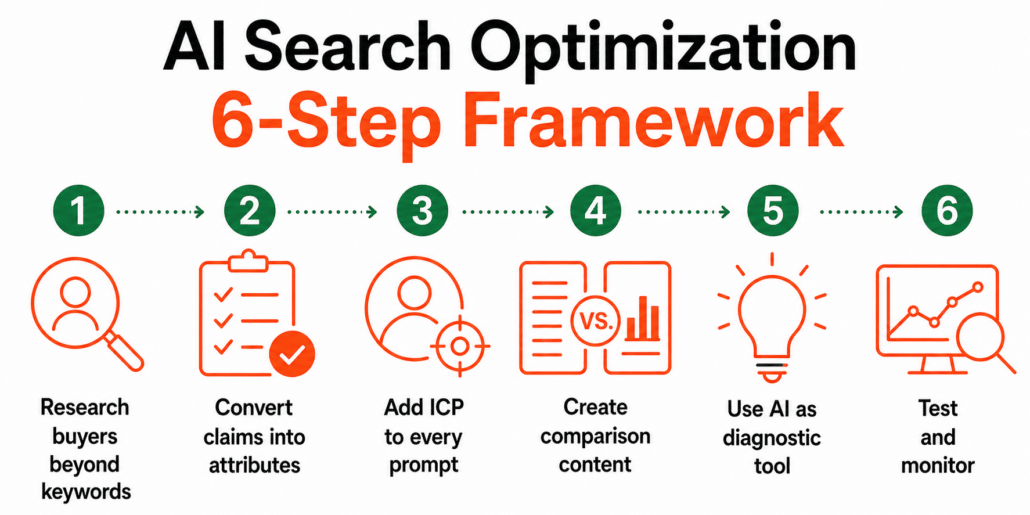
How to Close the Relevance Gap
- Research Your Buyer Beyond Keywords
Don’t rely solely on keyword tools. Listen to sales call transcripts. Interview customers about how they use AI to research solutions. Follow up with leads asking “What did you type into ChatGPT?” Monitor Reddit and community forums where customers discuss your category.
- Convert Claims into Attributes
Audit every page that makes a quality or performance claim. Ask: could a customer—or an AI—name three measurable features that support this claim? If not, that’s a content gap, not a content asset.
- Add Your ICP to Every Prompt
When using AI to audit or rewrite content, give it your ICP document first. Ask what that specific buyer would think of your brand, or what they’d need to see to choose you. You’ll get sharper answers than asking in the abstract.
- Create Comparison Content
Competitors win by saying what you won’t. Comparison pages control the narrative—silence lets them define you. Where are comparisons happening without your voice? Create that content, or their version of you becomes AI’s answer.
- Use AI as a Diagnostic Tool
Ask AI directly why your brand isn’t mentioned. Use prompts like “Why isn’t [my brand] on this list of top providers?” The AI itself is the best tool for understanding its decision-making.
- Test and Monitor
Run your three-prompt sequence regularly. Monitor how AI describes your brand across platforms. Find the gaps. Fix them. Repeat.
The Urgency Factor
Many LLMs have a knowledge cutoff date—sometimes a year in the past. Data before that cutoff is more accessible than data published after. Content not updated in 12+ months receives significantly less AI traffic than refreshed versions.
You could be waiting six to eight months before updated content becomes maximally visible and citable.
Don’t wait. Update your pages now.
The Gap Was Always There. AI Just Made It Impossible to Ignore.
Keyword research told us what people typed into search engines. It didn’t tell us what they actually needed to know. That gap was always there. AI just made it impossible to ignore.
The fix isn’t complicated. Talk to your customers. Find out what they really want to know. Publish content that’s specific, detailed, and built around measurable product attributes AI can reason with. Make sure your messaging is consistent across your entire digital footprint.
If you do that, you’ll show up in the AI conversations that matter. Your competitors who are still chasing keywords won’t.
Frequently Asked Questions
Q: Should I stop doing keyword research entirely?
No. Keyword research still shows you what people are searching for. Just don’t let it be your only input. Combine it with customer conversations, sales call transcripts, and community monitoring.
Q: What’s the difference between training data and web search responses?
AI answers come from two sources: training data (what the model learned during training, no citations shown) and web search (real-time retrieval, citations shown). Different prompts trigger different retrieval mechanisms, requiring different optimization strategies.
Q: Which AI platform should I optimize for?
If you’re doing SEO, optimize for Google’s AI Mode and AI Overviews, which use Gemini. But don’t ignore ChatGPT and Claude.
Q: How often should I update my content for AI?
AI shows a content recency bias—preferring recently updated content on topics that change frequently. Audit high-performing content that hasn’t been updated in 12+ months. At minimum, review your most important pages quarterly.
Ready to close your relevance gap? At Fire&Spark, we help brands figure out where AI is getting them wrong and how to fix it. Talk to a strategist to get started.


