
Three days ago, I was sitting outside my house when my neighbor pulled up in a brand-new red Lexus. Beautiful car. I’m jealous because my car literally leaks from the sunroof.
I asked her about it. She said she didn’t spend much time at the dealership because she did all her research on ChatGPT. She told the AI what she needed: room in the back for her one-year-old, a pretty color, and something small enough to fit in her garage. ChatGPT recommended the specific dealership down the street. She typed that dealership name into Google, visited their website, and bought the car.
That journey is now typical.
Your customers start with AI, get a brand recommendation, then search for that brand directly. The dealership sees a branded search in their analytics. They have no idea ChatGPT sent that customer.
How AI Search Optimization Actually Works
When I type “electric toothbrush for kids” into Google, I get an AI Overview at the top of the page. There’s a citation on the right side. Getting cited is nice. But the real value sits at the top of that response: the recommended brand. That’s the position that generates customers.
LLMs don’t care how many times your target keyword appears in your H2s. They care whether your content actually explains what the person asking needs to know. AI will skip past a keyword-optimized page to cite the one that does.

Citations get you noticed. Recommendations get you paid.
When AI platforms like ChatGPT or Google’s AI Overviews try to choose brands for a customer, they start by considering many options in your category. AI has access to information about countless brands from its training on the entire web.
From there, AI narrows down to a shortlist. In that toothbrush example, five brands appeared in the AI Overview. But only one sat at the top. That’s the recommendation position.
For traditional SEO, we optimized for technical fixes, content, and backlinks to earn rankings that generated traffic. For AI search optimization, we’re focused on that recommendation. We want our brand in the customer’s mind so they search for us by name.
AI platforms match customer preferences against product and brand attributes. My neighbor told ChatGPT she needed room for a car seat, a specific color, and a car that fit her garage. AI matched those requirements against what it knew about different dealerships and vehicles.
If your brand information is missing, vague, or inconsistent across the web, AI cannot make that match. You get skipped.
What Is the Understanding Gap in AI Search?
Most brands fail at the first step. They don’t understand what their customers are actually asking.
Imagine you sell work boots. Your website answers the question: “Are these shoes safe for a job site?” That’s helpful. But your customers are actually asking ChatGPT: “Do these boots have a steel toe?”
If that specific information isn’t online, AI won’t recommend you. AI doesn’t think you have what the customer is looking for.
You cannot close this gap without understanding your customers. What questions do they ask when searching for products like yours? What information do they need to make a purchase decision?
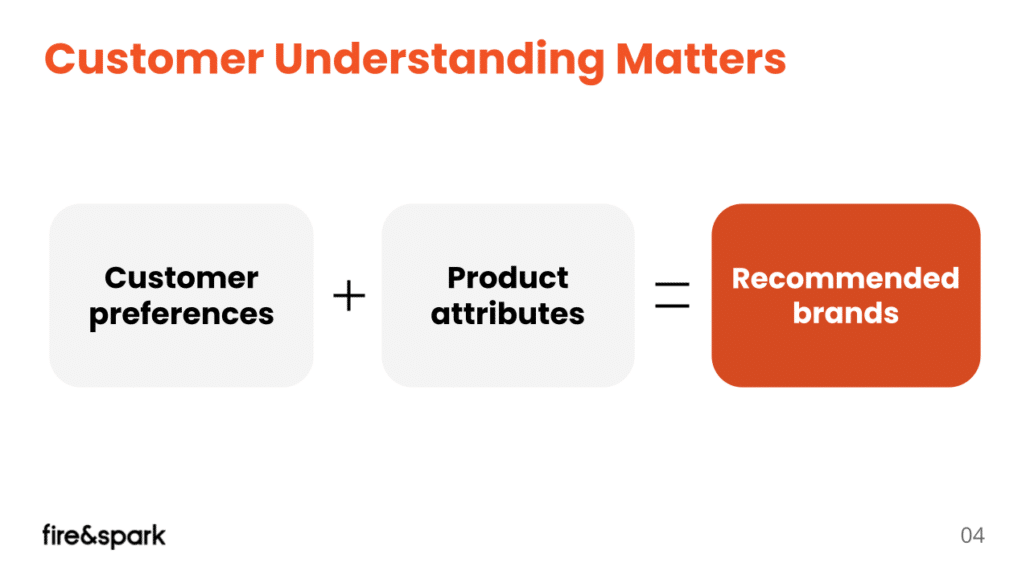
AI already knows because it’s in conversation with your customers constantly. You need to catch up.
Customer research for AI search optimization looks different than keyword research. I pull questions from Reddit threads and Facebook groups. I dig through niche forums, sales call transcripts, and customer support tickets. Keyword research still has value, but we’re not using it to select target keywords. We’re using it alongside qualitative sources to understand what customers actually care about.
Then we monitor AI visibility using prompts crafted from that research. Not prompts some visibility tool generates automatically, but rather prompts that reflect how real customers talk to AI.
Why Does Brand Relevance Matter for AI Recommendations?
Once you understand what customers need, your brand has to be relevant to those needs. Otherwise AI will substitute a competitor.
You might publish content about shoes “engineered for comfort.” But your customers are asking AI for “the best walking shoes under $100.” If that specific information doesn’t exist anywhere online, you won’t get recommended.
Here’s the psychology behind this. Research shows humans hold roughly seven things in working memory when making decisions. Price, reliability, size, reviews. We process somewhere around seven factors.
AI has no such limitation. It can consider millions of attributes about your brand when deciding whether to recommend you. This changes how we think about brand building.
For humans, we simplify. “Just do it.” That works for human brand recall.
For AI, we need specificity. AI doesn’t understand what “just do it” means. When AI is in conversation with a marathoner who needs a shoe before catching a flight to Sydney, with specific weight requirements and size constraints, AI can only make that recommendation if it understands all the product attributes.
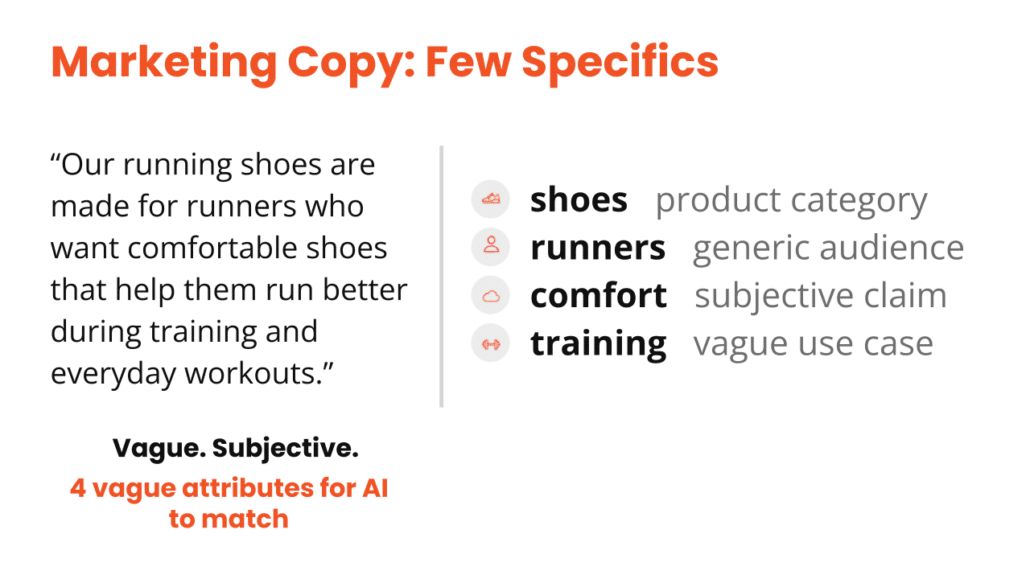
Look at generic marketing copy: “Our running shoes are engineered for comfort and built for training.” AI learns you sell shoes for runners. That’s it.
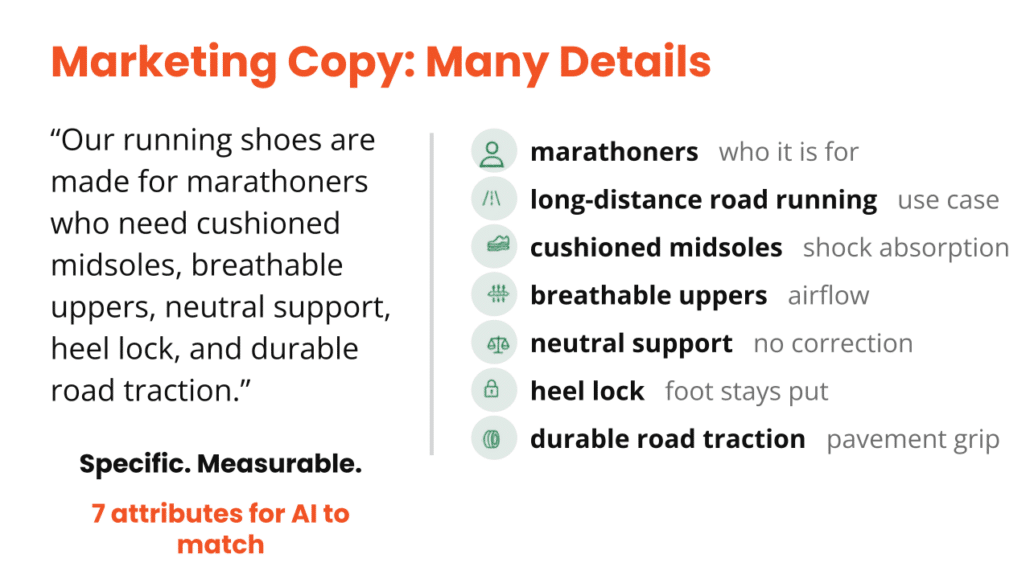
Better copy: “Our running shoes are made for marathoners who need cushioned midsoles, breathable uppers, neutral support, heel lock, and durable road traction.”
That’s seven specific attributes AI can match against customer requirements. You get my point
But products aren’t enough. You need to educate AI about your target customers and use cases. When should AI recommend your brand? For which types of buyers in which situations?
I’ve seen software companies create profile pages on their websites featuring specific customers and use cases. These pages train AI on when to make recommendations. Detailed product pages include customer information. Third-party review sites describe who the product works best for.
AI learns from all of it.
How Does Online Reputation Affect AI Search Visibility?
The reputation gap is the difference between what you want customers to know about your brand and what the internet actually thinks.
Research published in Harvard Business Review examined how brands appear across AI platforms. The researchers sent product prompts to ChatGPT, Claude, and Gemini and found striking inconsistencies. Smaller brands like Brooks appeared reliably in running shoe recommendations while Nike, the world’s largest athletic brand, appeared far less consistently.
When brands don’t have consistent messaging across their digital footprint, AI platforms get confused about what those brands do, who they serve, and what problems they solve.
I ran a simple test. I asked Perplexity: “Are Mac laptops good for gaming?” It said yes, modern Mac laptops are good for gaming. Then I checked a Google AI Overview for the same question. It said Mac laptops are not the best choice for gaming.
Totally inconsistent answers because AI sees different things across the web.
Your digital footprint includes what you say about your brand on your website, social channels, and thought leadership. It includes what customers say in reviews and case studies. It includes what the market says on LinkedIn, in online communities, and at industry events.
And unfortunately, it includes what your competitors say. A competitor can publish an inaccurate comparison page that casts your products in a bad light. AI reads that too.

The only solution is consistent, accurate messaging across your entire digital footprint. This requires coordination across content teams, PR teams, SEO vendors, and social teams. For one enterprise client, I work with a contact who used to sit in the SEO department. Now her job is coordinating messaging across all these teams. It works because the CMO is on board. The CEO told everyone that AI messaging matters. That’s why they appointed one person to own it.
This coordination is new. SEO was one channel. AI search optimization requires getting multiple channels right simultaneously.
How Do You Measure AI Search Success?
Traditional SEO success looked like number one rankings and organic traffic going up and to the right. For AI search optimization, success looks different.
Organic traffic might go sideways. It might go down. That’s the reality many marketers face right now. Your manager asks what happened.
But if revenue is going up and customer acquisition cost is going down, those are the metrics that matter.
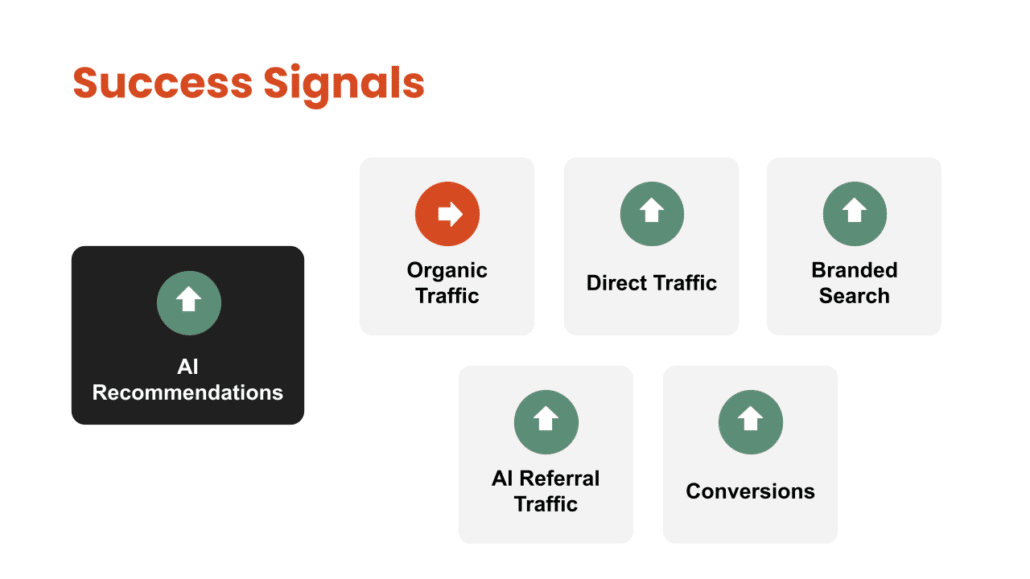
The success signals I track include AI recommendations. I want brands recommended by AI. That shows up as direct traffic growth in analytics, branded searches increasing, and conversion rates climbing.
You won’t get perfect attribution. The influence AI has when making recommendations happens in the dark. But you can see the downstream effects in your analytics.
I also audit AI visibility manually. You can ask ChatGPT or Gemini: “Who are the best brands in my category?” or “Tell me about my brand.” Do it many times because responses change. Use a customer persona in your prompt to see how AI perceives your brand for specific buyer types.
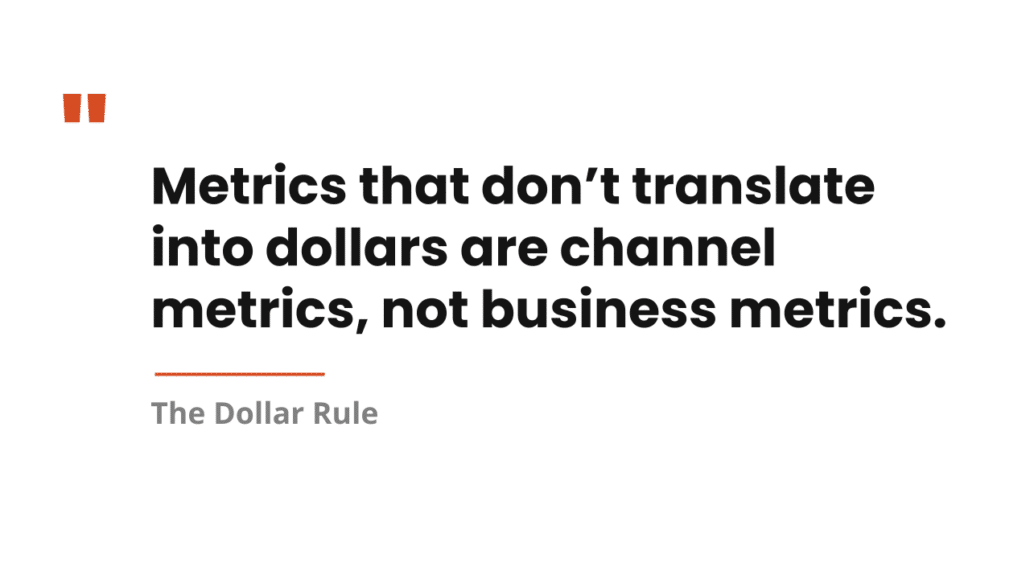
The bigger shift is moving from channel metrics to dollar metrics. Rankings and organic sessions help optimize the channel. They don’t tell your CMO whether you made money.
What leadership cares about: revenue, pipeline, and customer acquisition. Those outcomes determine bonuses. Those are the conversations that keep marketing budgets funded.
I focus on dollar-denominated metrics like customer acquisition cost, lifetime value, and payback period. When I pitch AI search investment, I frame it this way.
Imagine you run a business installing audio visual equipment for local businesses. You estimate 500 companies in your market will purchase installation services this year. Your AI visibility monitoring shows your brand appears 20% of the time when those businesses research on ChatGPT. Your conversion rate is 25%. Your average deal is $60,000.
Multiply that out: 500 purchases × 20% AI visibility × 25% conversion × $60,000 = $1.5 million in AI-influenced revenue.
That number represents how much of your revenue this year will be influenced by AI search. Not attributed directly. Influenced.
If you increase AI visibility from 20% to 80%, that $1.5 million becomes $6 million. A difference of $4.5 million in AI-influenced revenue from your optimization efforts.
This math is directionally correct. It’s fuzzy, not perfect attribution. But it gives leadership a framework for understanding the investment. It connects AI search to dollars they care about.
The pitch sounds like this: “AI currently recommends us 80% of the time for the 500 local businesses buying services like ours this year. That’s up from 20% last year. At our 25% win rate and $60,000 average deal size, AI will influence $6 million of revenue. That’s up from $1.5 million. A difference of $4.5 million in AI-influenced revenue from our GEO efforts.”
That’s a conversation any CFO can understand.
Getting Started with AI Search Optimization
The brands winning AI search are closing these gaps systematically.
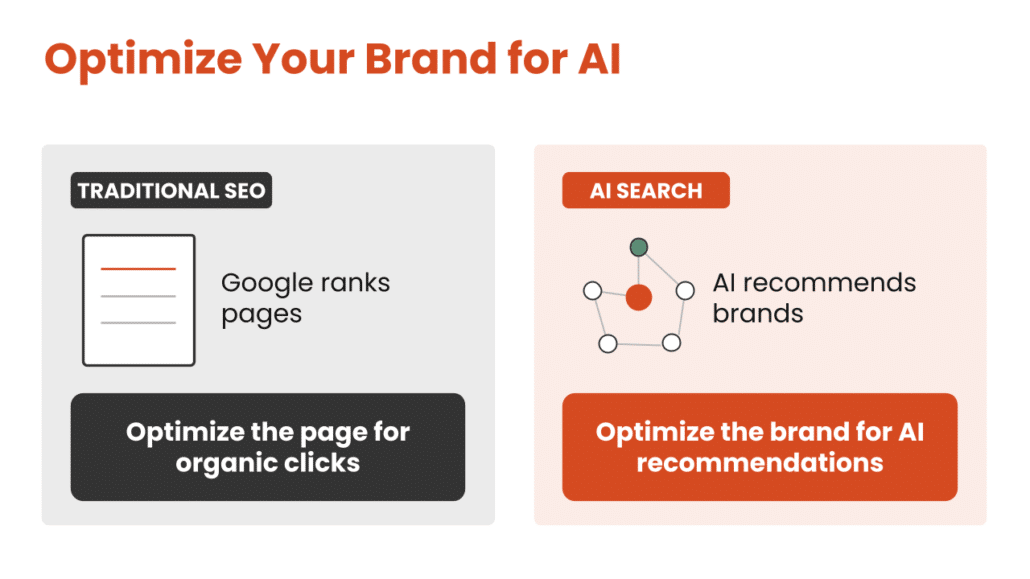
They research their customers to understand the real questions being asked. They build relevant content with specific attributes AI can match against customer requirements. They maintain consistent, accurate messaging across their entire digital footprint. And they measure success in dollars.
Your customers are already having conversations with AI. They’re getting recommendations. They’re searching for the brands AI suggests.
The question is whether those recommendations include you.