by Dale Bertrand ⏐ June 1 2026
Several years back, my daughter was desperate for a Nintendo Switch. Her evil parents (that’s me and my wife) wouldn’t just buy it for her. She was too young to get a job. So she did what any resourceful kid would do: set up a lemonade stand in front of our house.
What made me proud wasn’t the entrepreneurial spirit. It was that she ran a high-stakes A/B test.
Her hypothesis: visibility drives sales. More people stopping means more lemonade sold. More lemonade sold means Nintendo Switch money faster. So she tested two variants to figure out which would get more cars to pull over.
Variant A: Her two-year-old sister Julie, stationed out front with maximum cuteness.
Variant B: Our dog Ginger, who admittedly is also very cute.
Which one won? Sister. Not even close.

At the end of the day, when my daughter was counting her crumpled bills and loose change, she didn’t care about the A/B test results. She didn’t care about visibility metrics or the quality of her lemonade or even how many people stopped by. She cared about one thing: Did I make enough money to buy the Nintendo Switch?
That’s the outcome. Everything else is just measurement in service of getting there.
AI Search Broke Attribution (And That’s Actually Fine)
Let’s be honest about where we are. Traffic growth is divorced from business growth. AI is stealing clicks. There’s dark traffic hiding in your direct bucket that GA4 can’t explain.
One study found that 70% of AI referral traffic lands in direct. Which means “direct” now just means “we have no idea where this came from.”
We’re dealing with zero-click searches, dark AI traffic, and intent we can’t track. The metrics we’ve used for twenty years to justify SEO budgets have major blind spots now.
So what do you do when you can’t measure what you used to measure?
You stop pretending you can. And you get comfortable with a different kind of math.
Precision vs. Accuracy: An Engineering Detour
I studied engineering in school. We talked a lot about precision versus accuracy. They’re not the same thing.
Precision is how exact and repeatable your measurements are. Down to the decimal point. In marketing terms, that’s clicks, rankings, impressions. Numbers you can pull from a dashboard and report to three decimal places.
Accuracy is how close those measurements are to the thing you actually care about. The bullseye. The business outcome.
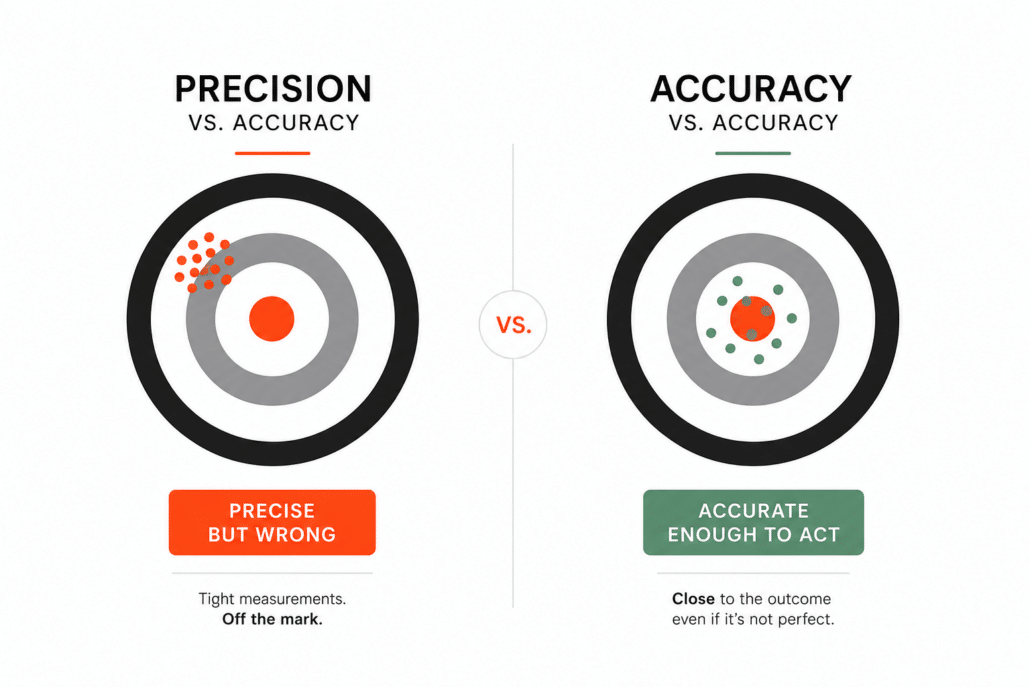
This is because precision can’t rescue accuracy. You can have the most exact click counts in the world. But if clicks don’t correlate to revenue anymore, that precision is worthless. You’re measuring the wrong thing really, really well.
What we need now are accurate measurements. Ones that point us toward business outcomes, even if they’re not precise. Even if the math is a little fuzzy.
The Healthcare Brand Who Refused to Compete
Let me tell you about a client. Healthcare sector. B2B. They had a competitor who published a comparison page. That page was full of half-truths and misleading differentiators. The competitor owned the narrative in AI search results. When people asked ChatGPT or Perplexity to compare these two companies, the competitor’s framing won.
I wanted our client to publish their own comparison content. Fight back. Take control of the story. But they wouldn’t do it. Legal concerns. Brand concerns. The usual.
So I had to prove the financial damage of doing nothing.
First, I looked at traffic. Our SEO tools said the competitor’s comparison page was getting maybe 40 organic clicks a month. What can you even do with that number? It doesn’t include AI traffic. It doesn’t include the indirect visits from people who saw the comparison in an AI answer and then Googled the competitor directly. Forty clicks tells us almost nothing.
But here’s what we DID know:
- That page was appearing in 64% of the AI responses we were monitoring for decision-stage questions
- It was getting backlinks
- It was getting shared on social
- 10% of the prospects who called our client’s sales team were mentioning specific facts from that comparison page, unprompted
That last data point wasn’t quantitative. It was anecdotal. But we couldn’t ignore it because it was real.
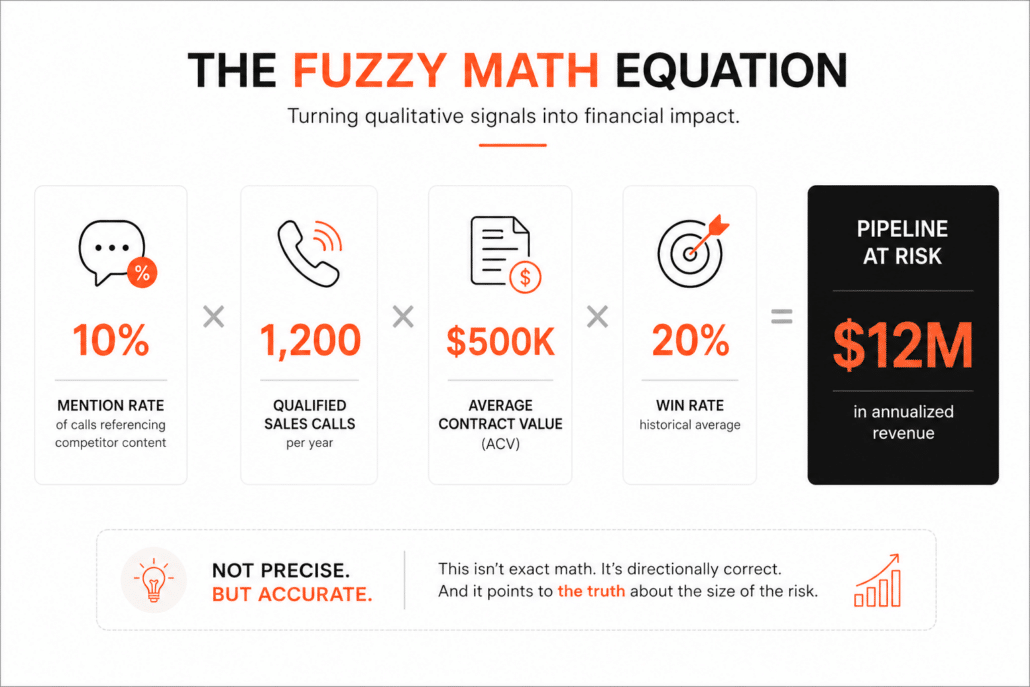
So we did some fuzzy math.
10% mention rate × 1,200 qualified sales calls per year × $500,000 average contract value × 20% win rate = $12 million in annualized revenue being shaped by the competitor’s narrative instead of ours.
If your SEO strategy is still built around trophy keywords, you’re optimizing for the past. AI interfaces reward specificity, context, and intent.
This is where younger brands can outrank incumbents. This is where AI search is most likely to hand you an edge.
Is that math precise? No. Could a finance person poke holes in it? Absolutely. But it’s accurate. It points toward the bullseye. It tells leadership something true about the magnitude of the problem.
And when I reframed the conversation from “we need comparison content to improve our AI visibility” to “we have $12 million in pipeline being shaped by our competitor’s messaging, instead of ours,” suddenly the legal concerns got a lot more negotiable.
Your CFO Thinks Like a Ten-Year-Old (In the Best Way)
Remember my daughter counting her crumpled bills after the lemonade stand closed? She didn’t care which variant won the A/B test. She cared whether she had enough money for the Nintendo Switch.
Your CFO thinks the same way. I mean this as a compliment. They don’t care about impressions or citation share or visibility scores. They care about the outcomes that show up on financial statements: revenue, pipeline, payback periods, and customer acquisition costs.
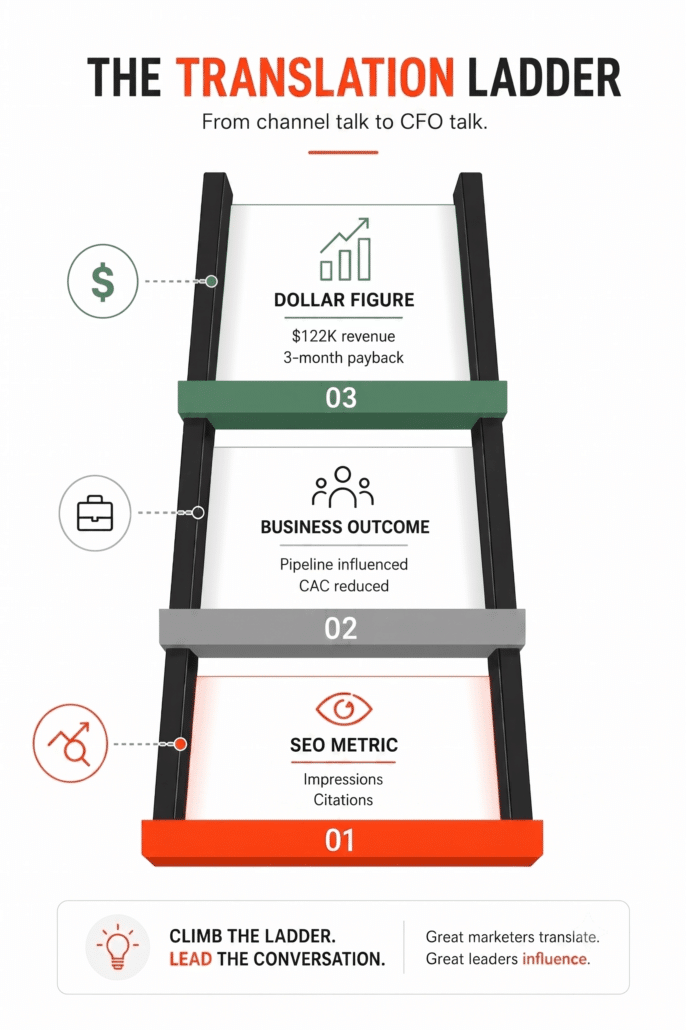
When you walk into a budget meeting talking about how your AI visibility went up 23%, you might as well be speaking German to someone who only understands English. It’s not that the work doesn’t matter. It’s that you haven’t translated it into a language they can act on.
And right now, that translation problem is worse than ever.
The Dollar Rule Framework
After doing this kind of work for a few years now, I’ve landed on a framework I call the Dollar Rule Framework. It’s how I think about every metric I report, every budget I pitch, every conversation I have with leadership about GEO.
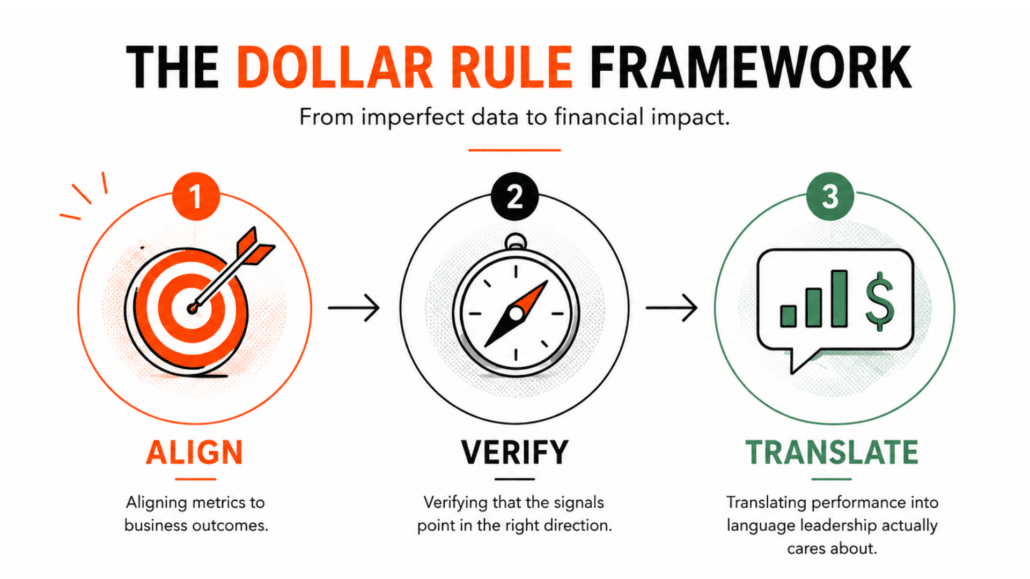
The framework has three components: Align, Verify, and Translate.
Align. Is this metric aligned with business outcomes? Revenue, pipeline, customer acquisition cost, payback period. If the metric goes up, does the business actually get better? Or is it just a number that makes marketers feel good? Your metrics need to point toward the outcomes your leadership actually cares about. Not impressions. Not citation rates. Dollars.
Verify. Is this metric accurate? Does it point toward the bullseye, even if it’s not perfectly precise? When it moves in one direction, does that reliably indicate we’re making progress on what matters? This is where fuzzy math becomes your friend. You’re looking for directional accuracy, not decimal-point precision. Can you verify that the trend is real and meaningful?
Translate. Is this metric in the language of leadership? CFOs speak in dollars. CMOs speak in growth rates and market share. They don’t speak in impressions or citation rates or SERP features. If you can’t translate your metric into their language, you haven’t finished your job.
Every metric should pass all three tests. If it doesn’t, you’re either measuring the wrong thing or communicating it the wrong way.
The Dollar Rule in Practice
Here’s a practical application. Before you report any metric to leadership, ask yourself: can I transform this into a dollar figure?
Not “our organic traffic increased 15%.”
Instead: “our website content generated $340,000 in attributed pipeline this quarter, up from $290,000 last quarter.”
Not “we improved our citation share by 8 points.”
Instead: “our local search optimizations contributed to a 12% reduction in customer acquisition cost versus paid channels.”
Not “our content is ranking for more decision-stage keywords.”
Instead: “the payback period on our GEO content is now three months, meaning every dollar we invest returns to us within a quarter and then generates pure margin after that.”
Every metric should connect to an outcome your organization will fund. If you can’t draw that line, you haven’t thought hard enough about why the work matters.
How to Apply the Dollar Rule Framework
Here’s how you can start using this approach today:
- Audit your current metrics. Look at the last report you sent to leadership. How many metrics pass all three tests? How many are aligned with business outcomes, verified as accurate, and translated into dollar terms?
- Find the fuzzy math. What qualitative signals do you have that you’ve been ignoring because they’re not “data”? Sales call mentions. Customer feedback. Anecdotal patterns. These often point toward the bullseye better than precise traffic numbers.
- Build the translation layer. For every metric you report, create a conversion formula that connects it to revenue. Even if the formula has assumptions, document those assumptions. Your CFO will respect that more than a metric they don’t understand.
- Compare to paid. One of the most powerful translations is comparing your organic customer acquisition cost to your paid customer acquisition cost. This is language every CFO understands.
- Calculate payback periods. If you invest X in GEO content, how long until that investment returns to the business? Three months? Six months? This framing makes GEO feel like a financial decision, not a marketing gamble.
The Menswear Brand That Said No (Then Yes)
We pitched a GEO project to a menswear e-commerce client. The project was rewriting and optimizing all their product pages for AI search. Straightforward work. We knew it would help.
First pitch: “This will cost $20-30K and we estimate it’ll boost your impressions by about a million.”
They said no. Couldn’t connect impressions to business outcomes. Didn’t know if it would actually help them sell more clothes.
Two weeks later, same project, different pitch: “We want to optimize only your top-performing product pages. Investment is $20K. Based on your conversion rates and average order value, we estimate this will generate $122,000 in additional revenue with a three-month payback period. Pay us now, break even by next quarter, and everything after that is margin.”
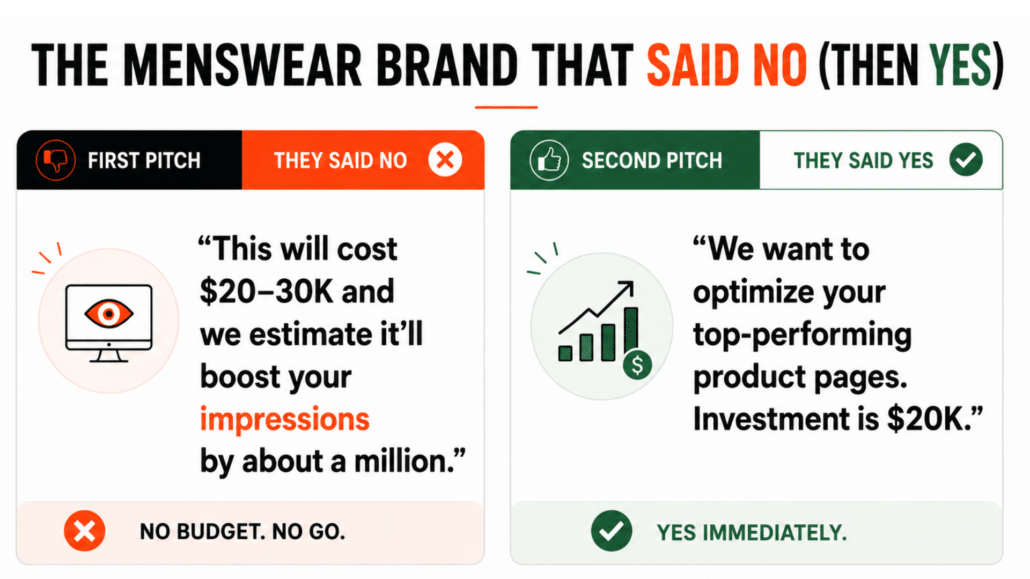
They said yes immediately.
Nothing changed about the strategy or the scope. We just translated what we do into language they could fund.
Stop Defending, Start Translating
The GEO attribution problem isn’t going away. AI search is going to keep eating clicks. Traffic metrics are going to keep getting noisier. The precise metrics we’ve relied on for two decades are going to keep drifting further from the outcomes that matter.
You can spend your energy complaining about that. Or you can get comfortable with fuzzy math, accurate-but-imprecise measurements, and the hard work of translating what you do into the language of business outcomes.
Your CFO doesn’t need perfect attribution. They need to understand why this work matters, in terms they can act on. Give them that, and the budget conversations get a lot easier.
My daughter didn’t need to know exactly how many people her sister convinced to stop versus how many would have stopped anyway. She needed to know if she had enough money for the Nintendo Switch. She did. The A/B test worked. And she learned something about measurement that most marketers still haven’t figured out.
The outcome is what matters. Everything else is just helping you get there.

Dale Bertrand is a marketer with extensive technical experience and an engineering mind. He focuses on SEO, content marketing and analytics for e-commerce and manufacturing companies. Before founding Fire&Spark, Dale built the machinery that runs the internet and managed marketing programs for Fortune 500 companies.