by Dale Bertrand ⏐ February 17, 2026
Key Takeaways
- Stop defending SEO with traffic. In 2026, clicks and rankings are unstable (AI Overviews, AI Mode, zero-click). Budget conversations need to lead with business outcomes instead.
- Measure what leadership actually funds: revenue actions. Track conversions you can defend—demo requests, trials, purchases, booked calls, pipeline created—and report SEO as an input to those outcomes.
- Prove SEO’s influence with “assist” signals. Use assisted conversions, multi-touch paths, direct traffic lift, branded search growth, and improved conversion rates in other channels to show SEO is building trust that makes everything convert better.
- Make SEO a competitive argument, not a channel argument. Benchmark the competitors leadership actually cares about: topic visibility on revenue-driving intent, coverage across the funnel, share of voice tied to pipeline, and presence in AI answers.
- Replace lost click data with buyer reality. When attribution gets messy, use customer interviews, intent-timed surveys, audience research tools, and smarter form questions (including AI usage) to prove demand still exists—even when the click never happens.
SEO used to be easier to defend.
Not because it was more valuable back then, but because it was easier to measure. We could point at organic traffic, keyword rankings, and neat little conversion paths in analytics. AI Overviews, AI Mode, and zero-click behavior are now breaking that story. Your customers are still searching. You’re just getting less credit for the work.
If you want SEO budget in 2026 and beyond, you need a new argument. One that doesn’t collapse the moment someone says, ‘Traffic is down.’ Here are three practical ways to justify your SEO budget in the age of AI search.
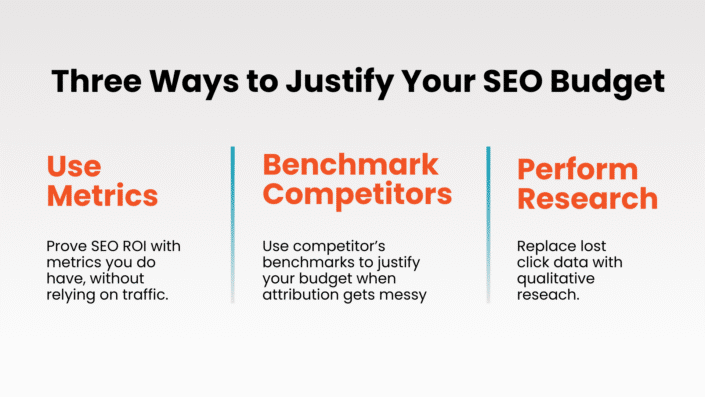
Here are three practical ways to justify your SEO budget in the age of AI search.
1. Use the Metrics You Still Have to Prove SEO ROI Without Relying on Traffic
Let’s get one thing out of the way: leadership doesn’t fund ‘SEO.’ They fund outcomes. And most SEO reporting still leads with the wrong outcomes.
Traffic is getting noisier. Rankings are getting weirder. The click is disappearing. If your entire case is built on those metrics, your budget is always one bad month away from being reallocated. The fix is not finding better vanity metrics. The fix is shifting to metrics that tie to revenue and business reality.
Here’s What Conversions To Track
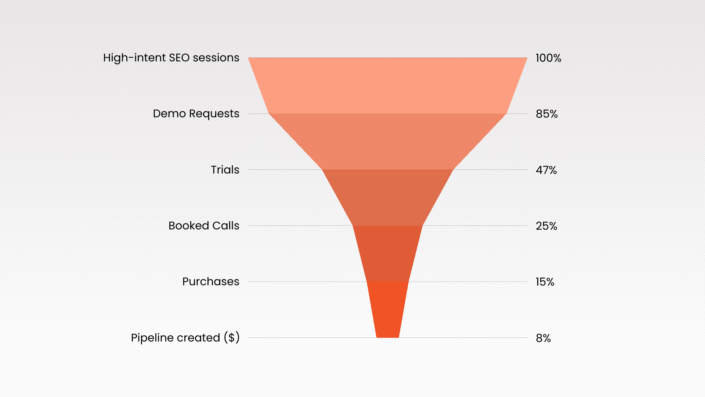
Track conversions you can defend.
If SEO targets high-intent searches, you should be able to connect that to:
- demo requests
- trials
- purchases
- booked calls
- pipeline creation
If the conversion is real, it’s measurable even if the path isn’t perfect.
Stop judging brand content like it’s performance marketing.
A lot of SEO content is doing brand work now, whether you planned it that way or not.
Top-of-funnel education rarely converts on the first visit.
It creates familiarity, it builds trust, and it makes other channels work better. If you treat those pages like they should convert directly, you’ll conclude they’re ‘not working.’ That’s not an SEO problem. That’s a measurement problem.
Use assisted conversions to show influence.
The paid team will happily take credit for 100% of revenue that appears in the paid conversion column. That’s convenient. It’s also often wrong.
SEO’s impact frequently shows up as:
- Assisted conversions
- Multi-touch journeys
- ‘Direct’ traffic lift
- Branded search demand increases
- Higher conversion rates in other channels because trust is already built
Your job is to make that visible. Tell the story in business language. When you report, don’t start with what you did. No one cares that you fixed canonicals. No one is impressed that you cleaned up redirects. Those are inputs.
Start with the business outcome, then explain what SEO did to contribute to it. That framing alone changes how budget conversations go.
2. Benchmark Competitors to Justify Your SEO Budget When Attribution Gets Messy
Executives don’t think in channels. They think in competition. They’re already comparing you to a handful of companies. The only question is whether your reporting acknowledges that reality. Competitor benchmarking is the fastest way to make SEO feel concrete again. The key is choosing the right competitors. Not the list your SEO tool generates. The competitors your leadership loses sleep over are the ones that matter. If you benchmark the wrong set, your work will feel irrelevant before you even open your deck.
What to Compare That Actually Lands With Leadership.
Here are the comparisons that turn ‘SEO’ into ‘market position’:
- Category visibility where buyers decide
Not every keyword matters. Focus on topics tied to pipeline and purchasing decisions. - Topic coverage by intent stage
Do you own the educational questions, the comparisons, and the decision-stage pages? Or does your competitor meet the buyer earlier and control the narrative? - Share of voice that maps to revenue
If competitors are more present on high-value topics, they’re getting more opportunities to shape the buyer’s decision. - Presence in AI answers
This is where it gets uncomfortable.
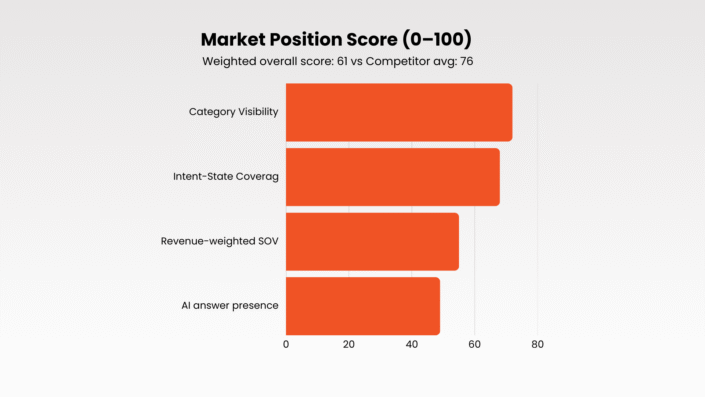
AI systems are now acting like a recommendation layer between the buyer and your brand. If your competitors are showing up in those answers and you’re not, you’re losing visibility in the exact moment the buyer is trying to decide. You don’t need perfect measurement to make this argument. You need clear evidence and a consistent tracking process.
How does this support the budget ask? Instead of, ‘We need money for content,’ you can say:
“We’re losing ground to these specific competitors on these specific revenue-driving topics, and here’s the plan to close the gap.”
That’s a conversation leadership understands.
3. Replace Lost Click Data With Qualitative Research That Proves Demand Still Exists
One of the most dangerous moments in marketing is when leadership mistakes ‘unmeasurable’ for ‘not happening.’ Search demand didn’t disappear. Attribution did. This is why qualitative research is suddenly budget defense, not just ‘nice to have.’
The real-world example: the click disappears, the decision still happens.
I watched a parent search for ‘preschools near me,’ see results, and then leave Google entirely to ask a local Facebook group what other parents recommended.
Zero clicks. Real decision. Real revenue.
That’s exactly what’s happening across industries now. People search, then validate elsewhere. Or they ask an AI tool and never visit your site. If you only look at analytics, you miss the whole story.
Use three inputs to prove behavior and explain the shift
1. One-on-one customer interviews
This is the gold standard. Analytics tells you what happened. Customer interviews can tell you why.
Questions to analyze their journey:
- Which platforms did they use first?
- When they brought AI into the process?
- What sources did they trust to validate the decision?
- What information did they need most (pricing shows up almost every time)?
2. Surveys at key moments
Don’t survey “in general.” Survey at the moment of intent:
- after a demo request
- after a trial signup
- at renewal
- after churn
3. Audience research tools
Find tools (e.g. Sparktoro) that show where your audience spends time, what they read, and who they trust help you map the ecosystem your SEO needs to influence.
4. Ask better questions
Ask a better question than “How did you find us?” on your contact forms? Most teams ask “How did you hear about us?” and get answers like “Google” or “a friend.” That’s not enough anymore.
Ask: “How did you start your search?”
Ask: “What AI platforms did you use for this search?”
This is how you prove to leadership that organic demand is still there, even if the click path is broken.
Bonus: Monitor AI Search Results to Protect Your Brand and Strengthen Your GEO Strategy
AI is recommending your brand right now. Some of its information about your brand is accurate. Some of it is outdated. Some of it is just wrong. That alone is a budget argument. Because ‘wrong’ doesn’t just cost you traffic. It costs you deals.
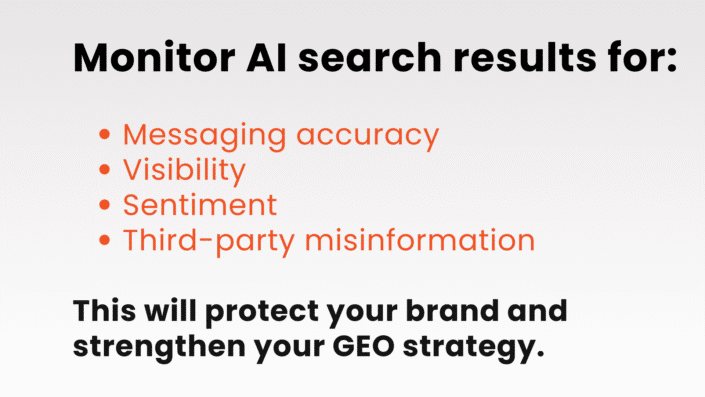
What to monitor
- Messaging accuracy: Does AI understand what you actually do?
- Visibility: Are you present for the questions you should own?
- Sentiment: What negative themes keep showing up?
- Third-party misinformation: Are competitors or old sources poisoning the narrative?
Try one of these AI monitoring tools:
Profound at https://www.tryprofound.com
Visto at https://www.getvisto.com
Peec AI at https://peec.ai
How to start without buying anything: Pick a set of prompts that reflect real buyer questions and can be repeated. Run them monthly in the AI platforms your buyers use. Save the outputs. Track what changes.
Now you have something leadership can see:
- What the market is being told about you
- What’s wrong
- Whether it’s improving
That’s GEO in a form your CFO can understand.
The 60-Second SEO Budget Pitch
If you want a simple script for the budget conversation, here are some options:
CFO Friendly Pitch
“SEO is the only acquisition channel that compounds. Paid stops the moment you stop spending. SEO builds equity. Yes, AI search complicates attribution. But we can still tie SEO to pipeline, track assisted conversions, and benchmark competitive visibility on the topics that drive revenue. The alternative, shifting budget entirely to paid, means higher CAC, zero evergreen assets, and complete dependence on platforms that raise prices every year. SEO isn’t a cost center. It’s a moat. The 2026 budget should reflect that.”
Straight-forward Pitch
“Demand didn’t disappear. Attribution did. We’re proving SEO’s impact three ways: tracking revenue metrics that still work, benchmarking competitors you already care about, and validating real buyer behavior with qualitative research. The customers are still searching. We’re making sure they find us.”
High Stakes Pitch
“Every month we don’t invest in SEO, competitors gain ground on the topics that drive our pipeline. AI is already recommending solutions to our buyers—sometimes us, sometimes not.
We’re not asking you to fund rankings. We’re asking you to fund visibility where decisions happen. Here’s how we prove it’s working: revenue attribution, competitive benchmarks, and direct customer research.”
Risk & Opportunity Framing
“We have two choices. We can pull back on SEO, because the traffic metrics look worse, and cede ground to competitors who are investing. Or we can adapt how we measure and capture demand where it’s moving to. AI search didn’t eliminate buyers. It eliminated clicks. The customers researching for us right now are getting answers from AI, reading content we either created or didn’t, and forming opinions before they ever talk to sales. The question isn’t whether SEO still matters. It’s whether we’re visible when the decision is being made.”
I hope these pitches for SEO budget are useful to you!

Closing Thoughts
Traffic declined. Demand didn’t. Your job is to prove it with revenue metrics, competitor benchmarks, and customer research that shows where buyers actually go. SEO in 2026 isn’t about being found. It’s about being recommended. Build the case. Protect the budget. Generate revenue that grows your business.

Dale Bertrand is a marketer with extensive technical experience and an engineering mind. He focuses on SEO, content marketing and analytics for e-commerce and manufacturing companies. Before founding Fire&Spark, Dale built the machinery that runs the internet and managed marketing programs for Fortune 500 companies.