How an eCommerce Brand Designed Content That Converts at 2.5x the Rate of Traditional Blogs

Industry: Ecommerce

Executive Summary

A leading menswear accessories retailer faced a common eCommerce challenge: driving organic traffic in a competitive market where informational searches rarely convert to sales. 

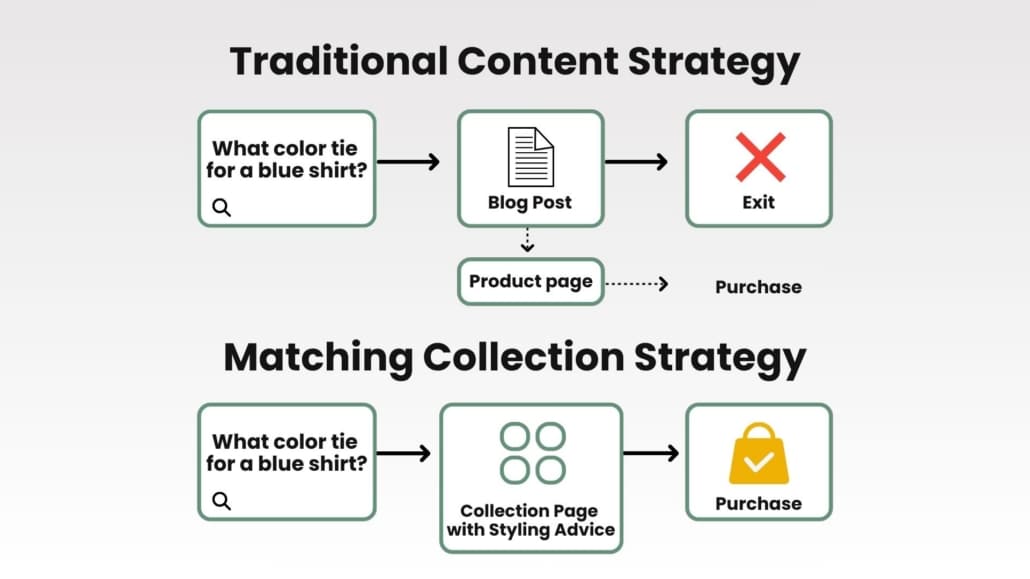
Fire&Spark developed a strategy that transformed FAQ-style matching queries into conversion-focused collection pages, directly answering questions like “What color tie goes with a blue shirt?” with shoppable product recommendations. 

The results speak for themselves: matching collection pages convert at a 4.8% organic add-to-cart rate — more than 2.5x the of traditional blog content — and delivered 90.5% more organic revenue in Q1 2025 than the same period the prior year. 

By capturing customers at the exact moment they’re seeking styling guidance, this approach proves that informational search intent and eCommerce conversion don’t have to be at odds.

Client Background

The client is a direct-to-consumer menswear accessories brand that has helped over 5 million customers look their best. From premium silk ties woven in Italy to affordable everyday essentials, the company offers 500+ styles spanning ties, bow ties, dress shirts, suits, and accessories. Their product range serves everything from daily office wear to weddings and special occasions.

The brand positions itself at the intersection of quality and accessibility, crafting refined essentials for weddings, business settings, and everyday moments. As a digitally native retailer, eCommerce performance is central to growth.

The Challenge

Overview

Like many online retailers, the client needed to capture organic traffic from customers who were searching but not necessarily ready to buy.

  • High-volume informational queries with low conversion: Customers frequently searched questions like “what color tie goes with a black suit” or “what tie matches a blue shirt.” These searches indicated purchase intent, but typical informational content, blog posts, and style guides rarely drove direct conversions.
  • Competitive landscape: Major fashion retailers and style publications dominated search results for matching and styling queries, making it difficult for product-focused pages to rank.
  • Gap between search intent and shopping experience: The client had product pages and some existing collections, but no systematic approach to capture customers at the moment they were asking styling questions.

The Solution

Fire&Spark identified an opportunity to merge informational search intent with conversion-optimized pages. Rather than creating traditional blog content that might rank but wouldn’t drive sales, the strategy focused on building collection pages that directly answered matching queries while showcasing relevant products.

  • FAQ-style collection pages optimized for matching queries: Fire&Spark developed and expanded collection pages targeting searches like “What color tie goes with a blue shirt?” and “What color tie goes with a black suit?” Each page opens with styling guidance—explaining which tie colors complement specific shirts or suits—then displays a curated selection of products that match those recommendations.
  • Bridging information and conversion: The pages answer the customer’s question immediately while putting the solution directly in their cart. A visitor searching for blue shirt tie pairings learns that burgundy, navy, and dark gray work well—and sees those exact ties ready for purchase.
  • Scalable framework: The matching collection approach created a template that could expand across product types, covering different suit colors, shirt colors, and occasions.

Implementation

The strategy built upon a small subset of existing collections the client had already created, expanding the approach systematically to cover more matching combinations. Each collection page featured:

  • A clear, direct answer to the matching question in the page headline and opening copy
  • Expert styling context explaining why certain color combinations work
  • Curated product selections filtered to match the query
  • Standard eCommerce functionality, including reviews, pricing, and filtering options

The approach leveraged higher search volume from informational queries while keeping users on pages designed for conversion—avoiding the typical drop-off that occurs when customers read a blog post and then leave.

Results

Fire&Spark’s matching collection strategy delivered measurable business impact across revenue, conversion, and search visibility.

A conversion rate that outperforms traditional content by 2.5x

The clearest indicator of the strategy’s effectiveness is the add-to-cart rate. In April, matching collection pages drove a 4.8% organic ATC rate. During that same period, the brand’s blog content converted at just 1.9%. That gap — more than 2.5x — reflects what happens when informational content and shoppable product pages are collapsed into one experience. Visitors don’t read and leave; they read and buy.

90.5% more organic revenue year-over-year

In Q1 2025, matching collection pages generated 90.5% more organic revenue than the same period in 2024, before the strategy was scaled. That growth happened despite increased competition — as other brands recognized the opportunity and launched similar pages — which makes the underlying performance even more meaningful.

Top rankings for high-intent styling queries

The pages rank where it counts. “What color tie to wear with navy suit” holds an average position of 2.5 for a query with 300 monthly searches. “What color tie with pink shirt” ranks at approximately position 1, capturing 150 monthly searches. Someone typing those queries has a suit laid out and a shirt in hand: they’re not browsing, they’re deciding.

Scalable framework for expansion

The matching collection template proved repeatable, enabling systematic expansion across product categories without requiring custom strategy for each new page. What began as a small subset of existing collections has grown into a reliable, structured acquisition channel.

AI search visibility

The structured, question-and-answer format of the collection pages positions the client well for AI-generated search results, where direct answers to styling queries increasingly appear in featured snippets and AI overviews.

Looking Forward
Long-Term Value

The matching collection strategy provides a foundation for continued growth — and the competitive pressure it has already attracted is itself a signal of its value. When other brands begin replicating your approach, it confirms you were early to something real.

Based on results, the client is expanding the strategy to cover additional product types beyond ties, applying the same framework to bow ties, pocket squares, and other accessories. The structured, question-and-answer format of these pages also positions the brand well for emerging AI search features, where direct answers to styling queries are increasingly surfaced in featured snippets and AI overviews.

Conclusion

This case demonstrates a key principle for eCommerce SEO: the questions your customers ask are often your highest-converting acquisition opportunity, if you build the right pages to answer them. Matching collection pages that converted at 4.8% organic ATC, outperforming blog content by more than 2.5x, didn’t happen by accident. They happened because the page design closed the gap between the customer’s question and the product that answered it.

The 90.5% year-over-year revenue growth in Q1 2025 shows the strategy’s scale. The fact that competitors are now following suit confirms its impact. And the expansion into additional product categories proves the framework travels: the same logic that works for tie pairings works for bow ties, pocket squares, and whatever category comes next.

Why Fire&Spark for Digital Health?

How do you create legally accurate content across 50 regulatory jurisdictions without spending years on research?

Fire&Spark’s answer was process design. By treating legal briefs as source documents, implementing AI-powered fact-checking, and building citation requirements into the workflow, we created a system where speed and accuracy reinforced each other.

The results speak to what’s possible when content strategy incorporates the right tools at the right stages. This client went from creating new FAQs webpages to ranking in three months, scaling to 200 pages with zero accuracy issues. The outcome: a content library they can trust and a process they can repeat as regulations evolve and their audience needs grow.

More Results

See how other digital health clients leveraged Fire&Spark’s SEO expertise for measurable success:

Ready to See How SEO Can Drive Results for Your Business?

Connect with Fire&Spark’s SEO strategists to discuss:

  • Aligning your SEO strategy with revenue goals
  • Identifying high-value customer acquisition opportunities
  • Developing a custom, ROI-focused SEO approach