by Emina Sarajlić ⏐ January 31, 2026
Key Takeaways
- Paywalls don’t hurt SEO by default, poor implementation does.
- The biggest risks come from duplicate URLs, broken internal linking, and unclear indexing strategies.
- You must decide upfront whether paywalled pages should rank, stay out of search, or coexist with a public version.
- Google supports lead-ins and metering under Flexible Sampling, but metered models are harder to implement cleanly.
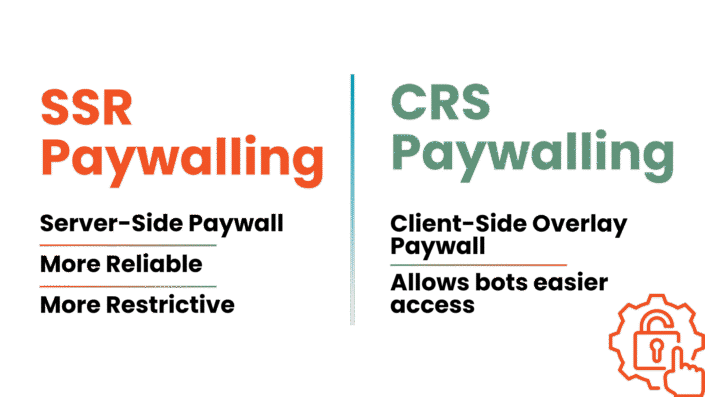
- Server-side paywalls are more secure, while client-side paywalls carry higher risks of content leakage and crawler mismatches.
- Paywalled content can still appear in search snippets and LLM citations unless explicitly controlled.
- Schema markup helps search engines correctly interpret gated content.
- Moving content from public to premium is a migration, not a toggle, redirects, links, and sitemaps matter.
- The goal isn’t to hide or expose everything, but to protect subscription value while consolidating SEO authority.
Most search teams typically shy away from recommending content paywalling because of the many nuances involved in managing a paywalled hub. A content paywall is a revenue choice, but many people fail to fully understand that it also changes how your site is crawled, indexed, and understood.
That doesn’t mean that paywalled content will always yield poor SEO results. If implemented correctly, paywalled content can both keep your site at the top of search engine results and LLM citations, while also providing an additional revenue stream for your publishing services and offerings. But again, this only works when implemented correctly.
The goal is not to “hide everything” or “index everything.” The goal is to pick a model that protects subscription value while still giving search engines enough clarity to rank the right pages and consolidate authority in the right place. Then it’s a win-win.
This article offers a full 4-1-1 into what paywalled content is, what paywall content structures Google officially supports, and SEO considerations you must take into account before you decide to paywall your content.
If you are interested in implementing a content paywall, keep reading!
What is Paywalled Content?
Paywalled content is any web page that requires a subscription, login, or purchase to access the full value of the content.
Usually, without login access, paywalled content is either completely inaccessible or only partially accessible, with a visual overlay blocking the text and images beneath it.
In practice, that usually looks like one of three experiences.
Content that shows a
- preview (lead-in) with the rest gated
- metered model where users get a limited number of full reads before a gate
- hard gate where everything is blocked until authentication
Why is Having Content Behind a Paywall an Issue for SEO?
Paywalls create SEO risks when they reduce crawl and discovery, split ranking signals across multiple URLs, or inadvertently create inconsistent experiences for users and crawlers.
The biggest SEO problems tend to stem from how paywalls are implemented, not from the fact that a paywall exists.
Here are five potential SEO issues when implementing a content paywall.
1. Content Duplication (If there’s a free resource hub with some overlapping content)
A common pattern we see is ‘public version + premium version’ that are materially the same. That setup often splits ranking signals unless you clearly pick one canonical, indexable version and demote the other.
Two details that matter a lot here:
- Google treats rel=canonical as a hint, but noindex as a directive, and noindex wins if both appear together.
- Blocking premium URLs via robots.txt alone can be unreliable if you truly need a page out of results, and disallow rules can also prevent bots from seeing relationships you actually want them to understand.
Solution: Decide which version deserves the SEO equity, then align your entire setup with that choice. Do not keep two near-duplicates live and hope canonical tags magically consolidate everything.
2. Internal links (If paywalled content is set to NoIndex)
If you noindex paywalled pages, internal links inside those pages become a weak foundation for discovery over time. Google has indicated that long-term noindex pages can have their links treated more like nofollow as the page stops being relied on and recrawled.
There is also a second, quieter issue: with a server-side paywall, links that live behind the wall may not be visible to Google at all because only the lead-in is rendered to bots. In that case, key links need to exist outside the wall in navigation, lead-ins, related modules, or other indexable blocks.
Finally, if the noindex tag is not implemented immediately as the page is launched, you risk the paywalled content getting indexed regardless; because Google may take days, weeks, or even longer to revisit your page and see the new robots tag.
3. Bounced Sessions from Non-Paying Users Lowering Rankings
A paywall can increase ‘land and leave’ behavior from users who are not ready to subscribe. That is not automatically an SEO penalty, but it exposes a bigger risk. It prevents deeper engagement, internal exploration, and organic linking.
If the search result promises one thing and the user hits a hard stop too quickly, you may see more short visits and fewer positive downstream actions.
Over time, that can show up as weaker performance, because search engines will determine the content is not meeting intent well enough to earn the signals that strong pages typically earn.
4. LLM Citations/Crawling
If premium content is crawlable, it may be used in AI answer experiences (or even training, depending on the vendor and platform).
Many publishers are now making deliberate decisions about whether third-party AI crawlers should access their content.
If you decide to limit access, one common approach is to use robots.txt user-agent rules for major AI crawlers (e.g., GPTBot, OAIBot, ChatGPT-User, Google-Extended, Perplexity bots, and Claude bots).
Two important limitations still apply:
- Robots.txt is not enforcement. If strict control matters, authentication and server-side gating are stronger.
- Google AI experiences may still rely on Google’s core crawling systems. Some controls can limit specific uses, but they are not a universal “block AI” switch.
5. Content “leaking” with JS-enabled Paywalls
Client-side overlay paywalls are popular because they are fast to build, but they can leak by design. If the full HTML is delivered to the browser and JavaScript simply blocks reading, the content exists in the page source and can be harvested.
These setups also have a higher chance of mismatches between what crawlers and users effectively receive, which increases risk.
How To Choose Your Indexing Strategy for Paywalled Content
Before we talk about paywall types like metering, lead-ins, or registrations, you need to pick a clear indexing strategy. Most publishers fall into one of these:
Option 1: Let paywalled pages rank
If you want premium pages to appear in organic search, they should be crawlable and indexable, and they should clearly communicate that access is restricted. Many publishers pair this with a preview model so users and crawlers understand what the page offers before the gate appears.
Option 2: Keep paywalled pages out of search results
If you do not want premium pages to appear in search, the reliable approach is to use noindex at the page level (or via X-Robots-Tag), rather than relying on robots.txt alone when the goal is removal from results.
Option 3: Two versions exist (public + premium)
If you maintain a public version and a premium version, it becomes very easy to split signals.
The cleanest strategy is usually one primary URL that owns organic visibility, plus a supporting teaser or lead-in that does not compete for the same rankings. If you want the premium URL to rank, the public page should serve as a preview that points users to the premium experience.
Now let’s go into what a lead-in is…
What Types of Paywalled Content Does Google Support?
Google supports common publisher patterns under Flexible Sampling, including lead-ins and metering, as long as you implement them cleanly and accurately describe the paywall.
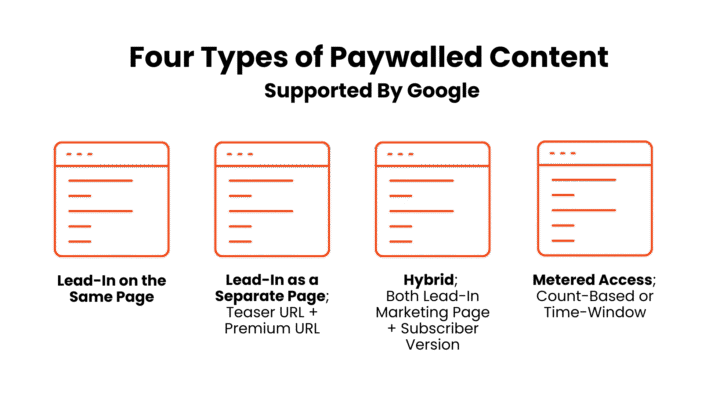
Here are the four types of paywalled content supported by Google.
1. Lead-in on the same page
This ‘single URL’ model shows a headline and intro, then gates the rest with an overlay. The SEO benefit is that links, engagement, and authority are consolidated into a single URL rather than split across multiple versions.
2. Lead-in as a separate page (teaser URL + premium URL)
This model uses a free teaser page and a premium page. It can be easier operationally, but it increases the risk of duplication and signal splitting if both pages cover the same topic too closely (and, by definition, they often do).
3. Hybrid (both lead-in marketing page + subscriber version)
Some sites create light versions of content for free visitors and then expand it with new, unique information for premium subscribers. This can work well when the two pages serve clearly different purposes and do not fight for the same intent.
4. Metered access (count-based or time-window)
Metering allows a user to read a number of pieces before prompting for subscription or registration. It can be strong for conversion and habit-building, but it introduces additional edge cases in crawling, tracking, and enforcement.
Why is Metering Trickier to Implement for SEO?
Metering, as stated earlier, is supported by Google, but it is also harder to implement because it adds uncertainty and complexity:
- Structured data is mainly built around ‘free vs not free,’ not nuanced metered states. You can not define a clean “metered” switch in markup.
- While not stating it explicitly, Google’s documentation alludes that metering should be used only when the access window resets on a repeat basis (IE, monthly), and not when access will be permanently blocked after a “trial” window.
- There is ambiguity about whether Googlebot should experience the same meter as users (IE get temporarily blocked from crawling after X amount of visits).
If you choose metering, plan for QA and post-launch observation as part of the release, not as an afterthought.
Cloaking Risk and How to Avoid Accidental Mismatches
Cloaking is the deliberate manipulation of search engine rankings by showing users different content than what’s available in the source code
Paywalls can drift into ‘cloaking’ territory when crawlers can access a materially different page than users. This is most common with JavaScript overlays and complex client-rendered experiences.
The safer goal is consistency: the preview experience should be reliably renderable and aligned for both users and crawlers, and gated sections should be clearly communicated as gated.
Moving Content from Public to Premium (What typically breaks)
Moving a library from public URLs into a premium section is effectively a migration. As such, it shares all the common possible breakpoints of any other migration: missing 1:1 redirects, redirect chains, outdated internal links, and stale sitemaps.
The clean approach is direct 301 redirects from each old URL to the new destination, plus follow-through on internal link updates and post-launch monitoring for 404s and indexing changes.
Snippet and Preview Controls
Paywalling does not mean you have to expose everything in search snippets. You can control how much appears in SERPs while still allowing discovery.
Two commonly used controls are:
- data-nosnippet on the gated portion if you do not want premium paragraphs excerpted
- max-snippet to limit snippet length when you want some preview but not full exposure
This can help you strike a balance: enough context for rankings and clicks, without giving away the premium value.
LLM and Bot Access Strategy
Publisher teams are increasingly separating two questions:
- What should rank in search?
- Who else should be allowed to crawl and reuse the content?
If you decide to limit third-party AI crawlers, implement that decision consistently across the site using robots.txt user-agent rules for the bots you care about.
If strict restrictions matter, rely more heavily on authentication and server-side delivery choices, since robots.txt is not enforced.
Is There a Schema Markup for Paywalled Content?
Yes. When any part of an indexable page is gated, you can use structured data to indicate that the content is not fully accessible for free and to identify the gated section(s).
A common approach is to set isAccessibleForFree to false, and use hasPart to identify the paywalled portion(s) of the page (often by referencing the relevant elements with selectors). After implementing the markup, validate it using Google’s testing tools.
This helps reduce ambiguity and makes it easier for search engines to interpret the page as ‘legit paywalled content’, rather than a broken or inconsistent experience!
Publisher SEO Support From Fire&Spark
Paywalls are where SEO, engineering, and monetization collide. If you are planning a paywall rollout, changing sampling, or moving a content library from public to premium, Fire&Spark can help you protect organic visibility while still protecting subscription revenue.

SEO Analyst at Fire&Spark™
Based in Bosnia & Herzegovina, Emina holds a BA degree in English Language and a Master’s in Comparative Literature. She has 9 years of SEO experience under her belt; zeroing in on content, strategy, research, and technical SEO. Working as an analyst at Fire&Spark since 2022, her focus niches include healthcare, eCommerce, and SaaS. When she’s not filtering keywords and analyzing SERPs, Emina spends her time exploring Bosnia’s mountains with her fiance, or cozying up with her three cats.