Digital Health SEO in 2026: How to Find Patients When Clicks Decline (and Conversions Matter Even More)

by Noah Goldfarb ⏐ March 4, 2026

Key Takeaways

  • Rebuild your SEO roadmap around intent, not volume. Prioritize queries that signal a patient is ready to evaluate or book (treatment + insurance + “online” + location).
  • Treat branded search as a core acquisition channel. Create/strengthen “Is this legit?”, reviews, prescribing policy, insurance/payment, and “what happens next” pages.
  • Design for “pre-qualified clicks.” Assume fewer clicks overall—so your landing pages must answer follow-up questions fast and clearly.
  • Win citations, not just rankings. Identify what sources AI uses in your category, then get featured there (roundups, directories, reputable editorial, communities). Tighten internal linking into a conversion pathway: treatment pages, FAQs, eligibility/insurance, first-visit expectations, and booking should all connect—no dead ends.

AI Isn’t ‘Killing SEO.’ AI Is Forcing SEO to Grow Up.

For telehealth-first patient acquisition, that’s a big deal—because the journey is already compressed. People arrive with high stakes, limited patience, and a short window between “I’m researching” and “I’m booking (or bouncing).”

Now layer on AI Overviews, ChatGPT-style discovery, and zero-click answers, and the old playbook starts to break:

  • “Let’s go after high-volume keywords.”
  • “Let’s celebrate traffic growth.”
  • “Let’s fix PageSpeed until the score is ‘green’.”

None of that is inherently wrong. It’s just incomplete.

The emerging reality is this:

Clicks are getting harder to win. But the clicks you do win can be more qualified, if you build your SEO strategy around intent, trust, and conversion

Noah Goldfarb, Digital Health SEO Specialist, presenting at the Digital Health Growth Mastermind by fire&spark. Quote reads: "Don't fight a losing battle to 'get clicks back'. Focus instead on capturing the RIGHT searchers and simplifying their conversion process.

Let’s break down what’s changing and what telehealth teams should do about it.

What AI Search Changes for Digital Health SEO

AI’s impact on search is important everywhere. In healthcare—and especially telehealth—those changes hit sooner and harder, because decisions come with friction baked in:

  • Trust concerns (“Is this legit?”)
  • Safety concerns (“Is this appropriate for me?”)
  • Logistics (“Do you take my insurance?” “How does prescribing work?”)
  • Privacy concerns (“Will this show up on my records?”)

AI tools are increasingly answering those questions before someone ever lands on your site.

That creates two new dynamics:

  1. More searches end without a click
    AI Overviews and “answer-first” SERPs reduce the number of visits available to capture.
  2. The visits you do get can be higher-intent
    If someone still clicks through after seeing an AI summary, they’re often further along in evaluation. Think of it as “pre-qualification” happening upstream. So the goal isn’t ‘recover every click we lost.’

The goal is win the right visibility, capture the right intent, and maximize the value of every visit that still arrives.

The Shift: Intent Over Volume

Here’s the nerdy truth: search volume is a lagging proxy for business value, and it’s becoming a noisier one.

In the pre-AI era, you could justify a lot of content decisions like this:

Big volume keyword → rank → get traffic → convert a small slice.

Now the middle of that equation is breaking. The “get traffic” step is less reliable, even when you rank well, because AI features can absorb the click.

So the question changes from:

“How many people search this?”

to:

“What is the searcher trying to do—and does that intent map to a patient we can actually help?”

A simple intent model that works well for telehealth acquisition

High-intent (patient acquisition intent):

  • “online suboxone doctor”
  • “telehealth anxiety medication”
  • “weight loss clinic online that takes insurance”
  • “IBD telehealth appointment”

Evaluation intent (brand + trust intent):

  • “[Brand] reviews”
  • “is [Brand] legit”
  • “[Brand] vs [Competitor]”
  • “does [Brand] prescribe [med]”

Informational intent (often valuable, but not always):

  • “what does buprenorphine do”
  • “symptoms of Crohn’s flare”
  • “how long does semaglutide take to work”

Informational content can still matter (especially for credibility and downstream conversions). But in a world where AI can summarize basic explainers, digital health brands need to be more selective about which informational topics they invest in—and how those topics connect to conversion pathways.

Which brings us to one of the biggest underrated shifts…

Branded Search Is Extra Powerful in the AI Era

I think branded search is underestimated right now.

In the old journey, someone researching a telehealth provider might:

  • read your site
  • check reviews
  • look at Reddit threads
  • skim a “best of” roundup
  • compare pricing pages

Now AI can do that synthesis in seconds. Which means people increasingly ask AI questions like:

  • “Is [Brand] legit?”
  • “Pros and cons of [Brand]”
  • “[Brand] vs [Competitor]”
  • “Is [Brand] covered by insurance?”

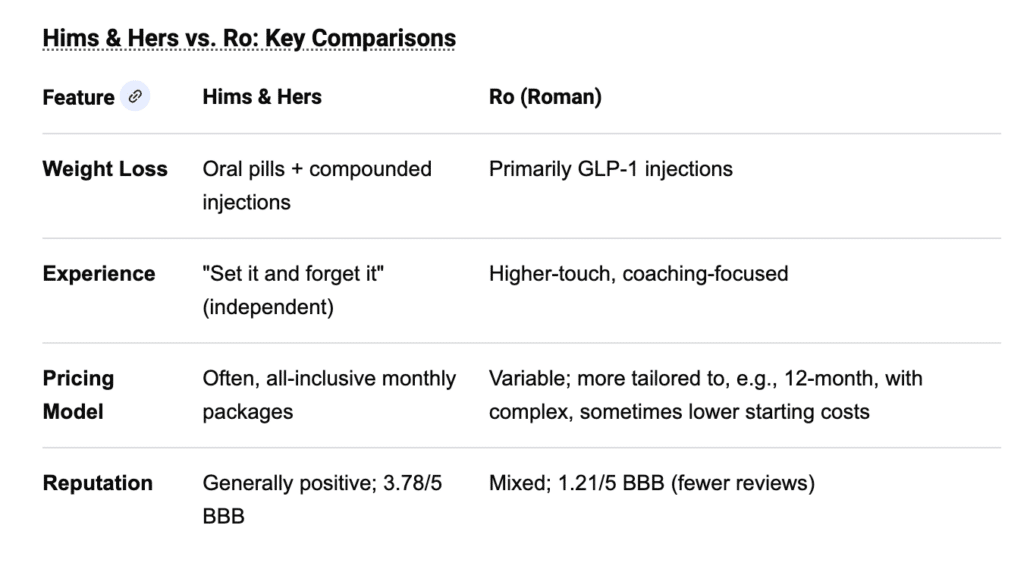
If you don’t control “is [Brand] legit?” answers, you don’t control patient acquisition.

Comparison table titled "Hims & Hers vs. Ro: Key Comparisons" across four features. Weight Loss: Hims & Hers offers oral pills and compounded injections; Ro primarily offers GLP-1 injections. Experience: Hims & Hers is independent and self-directed; Ro is higher-touch and coaching-focused. Pricing: Hims & Hers uses all-inclusive monthly packages; Ro uses variable pricing sometimes with lower starting costs. Reputation: Hims & Hers is 3.78/5 on BBB; Ro is 1.21/5 on BBB with fewer reviews.

(Captured February 2026)

That’s not a content problem. That’s a trust and narrative problem.

If AI is surfacing negatives about your brand, or just uncertainty, your SEO strategy can’t be limited to ‘rank for non-branded keywords.’ You need to influence the broader ecosystem that AI is pulling from.

What Digital Health brands should do here

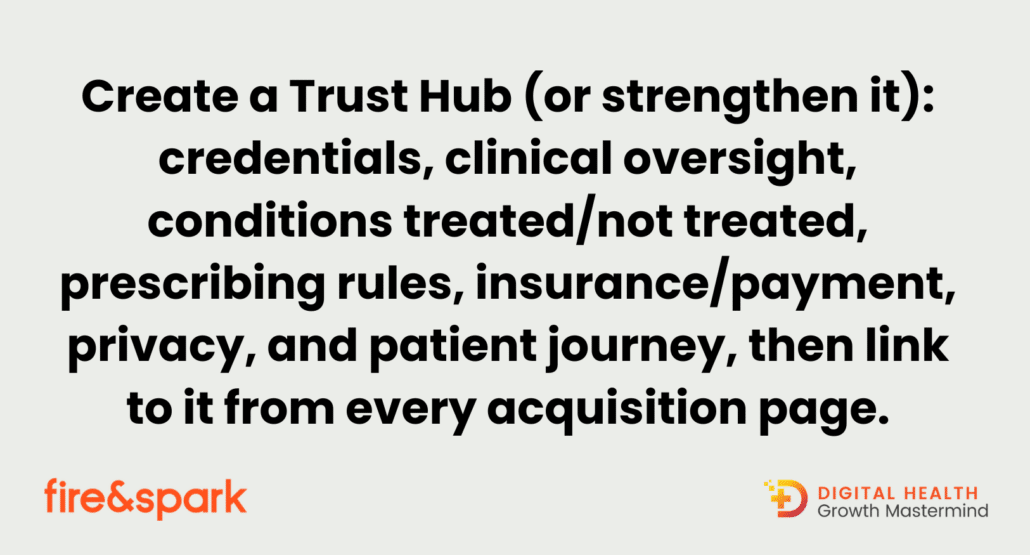
Slide with the text: "Create a Trust Hub (or strengthen it): credentials, clinical oversight, conditions treated/not treated, prescribing rules, insurance/payment, privacy, and patient journey, then link to it from every acquisition page."
  • Make sure your site clearly answers legitimacy questions:
    • clinical oversight and credentials
    • what conditions you treat (and don’t)
    • prescribing policy and safety protocols (where appropriate)
    • insurance/payment clarity
    • what the patient experience looks like end-to-end
  • Identify “off-site” trust signals that shape brand perception:
    • reviews and directories
    • editorial mentions
    • “best of” lists and roundups
    • community discourse (yes, including Reddit)

This is where SEO stops being a purely on-site discipline. Which leads to the next point.
In AI Search, You’re Not Just Competing to Rank. You’re Competing to Be Cited.

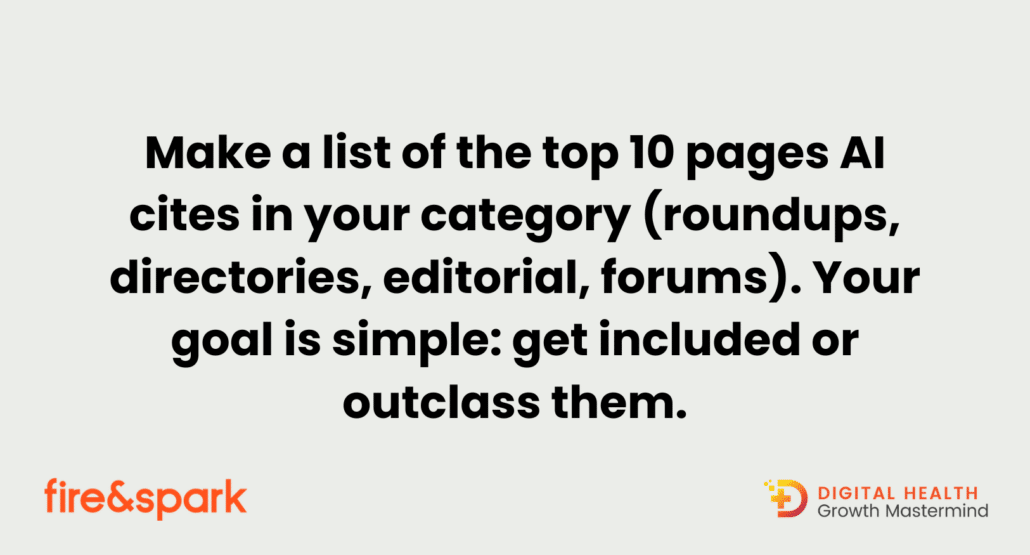
Slide with the text: "Make a list of the top 10 pages AI cites in your category (roundups, directories, editorial, forums). Your goal is simple: get included or outclass them."

A lot of AI answers are stitched together from existing sources.

So one of the most useful questions you can ask in 2026 is:

“What sources are shaping the answer in our category?”

Because if the AI Overview or LLM response is built from:

  • roundup articles
  • comparison guides
  • forums and communities
  • reputable editorial sites

…then your strategy can’t just be “publish another blog post and hope”.

You need to either:

  1. Become a source AI wants to cite, or
  2. Get featured in the sources AI already trusts

For telehealth brands, this is the strongest argument for tighter alignment between SEO and PR.

SEO in 2026 is partly distribution: getting your proof points repeated on credible third-party sites so AI repeats them too.

Not “PR for vanity headlines,” but PR for:

  • credibility signals
  • third-party validation
  • category authority

SEO teams should flag often-cited pages to their PR team, and collaborate on strategies to get included on those pages.

Think about it like this. AI is a pattern-matcher. If the web repeatedly associates your brand with positive, credible, specific proof points, AI outputs tend to reflect that

Site Architecture: Built for Bots and Humans (Especially Now)

AI crawlers and traditional search bots largely discover content the same way: sitemaps, internal links, and accessible architecture still matter.

But the more important layer for telehealth in 2026 is conversion reality:

If overall organic clicks decline, each click is more valuable, and your site needs to do a better job turning uncertainty into action.

The classic telehealth architecture mistake

Your most important pages, treatment pages, condition pages,’“this is what we do’ landing pages, are built like conversion dead ends.

You land on a page discussing “Opioid Use Disorder Treatment” and there’s nothing else to explore. No next steps. No “what happens on the first visit.” No clear pathways to get common questions answered.

The rationale is usually:

“We don’t want to distract. We want them to convert.”

The reality is:

Patients have follow-up questions. If you don’t answer them, they’ll leave and ask somewhere else (often AI, Reddit, or a competitor).

Add “Next questions” modules to treatment pages:

Diagram showing a Treatment Page linked to a "Next Questions" panel listing: Insurance/Coverage, Prescribing/Logistics, Safety/Eligibility, What to Expect (First Visit), and FAQs for This Condition, each with an arrow indicating a link.

What strong digital health site architecture looks like

A conversion-oriented website should accomplish two goals at once:

  • help a search engine understand relevance and relationships between topics
  • help a patient move through their conversion journey with minimal friction

Practically, that means:

  • a relatively flat hierarchy (key pages within ~3–4 clicks)
    • strong linking between:
    • treatment pages ↔ condition pages
    • condition pages ↔ FAQs
    • FAQs ↔ eligibility / insurance info
    • informational content ↔ “what happens next”
  • “related content” modules (static or dynamic) that reflect real patient questions

If your site is structured like a maze, bots struggle.

If your site is structured like a dead end, humans struggle.

Both problems show up downstream in performance.
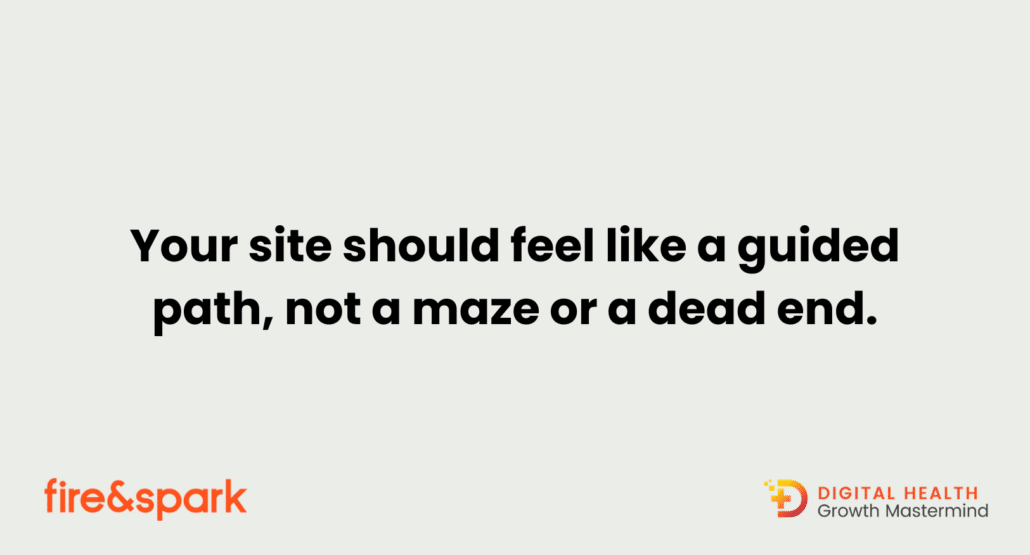
Slide with the text: "Your site should feel like a guided path, not a maze or a dead end."

Page Speed: Important, but Often Over-Prioritized

Every telehealth marketing team has had this moment:

“Our mobile score is 71/100. We need to fix it.”

Maybe. But don’t turn it into a religion.

In 2026, most websites are well-built, and most crawlers are effective at evaluating them. Page speed isn’t the lever it was 15 or 20 years ago. It matters most when it causes real user friction:

  • the page doesn’t load and users bounce
  • the experience is laggy enough to feel broken
  • core actions (forms, CTAs) fail or delay

We’ve helped hundreds of brands optimize their page speed. Its impact has diminished greatly over the years. In many cases, trying to improve a score becomes a dev-time sink without any ranking/traffic/conversion improvement, because the limiting factors are structural:

  • scripts and tracking
  • CMS constraints
  • third-party tooling
  • platform-level tradeoffs

In other words, it’s easy to burn a lot of time for marginal gains.

The more intentional approach is:

  • confirm whether speed issues are actually harming UX and engagement
  • prioritize the pages that drive patient acquisition
  • fix the issues that meaningfully reduce friction (not just the ones that move a score)

Telehealth is a mobile-first category. Speed isn’t optional. But ‘perfect score’ is rarely the hill to die on.

3 priority page categories for addressing speed/UX

  1. pages that drive consults/bookings
  2. pages with high bounce + low conversion
  3. pages where forms/CTAs lag or break

Ignore score-chasing that doesn’t change outcomes.
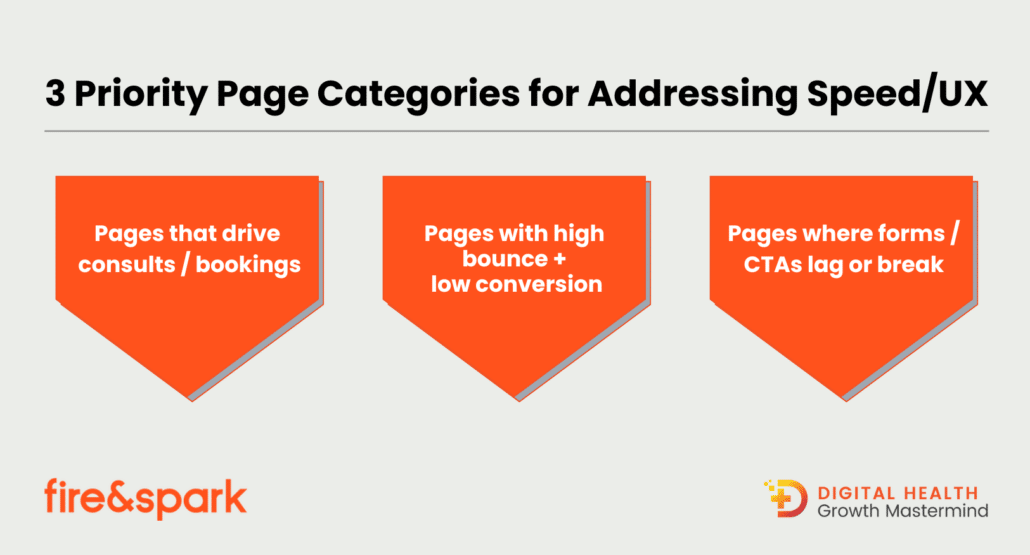
Graphic titled "3 Priority Page Categories for Addressing Speed/UX" showing three categories: Pages that drive consults/bookings; Pages with high bounce and low conversion; Pages where forms/CTAs lag or break

How to Find AI Visibility Opportunities When Data Is… Not Great

If you’ve tried to measure ‘AI visibility opportunities,’ you’ve probably noticed the tooling is still far behind what we’re used to for traditional search. Given the nature of AI search (long, custom prompts, highly differing responses based on user history), this isn’t likely to change any time soon.

So instead of pretending we have perfect data, we triangulate.

Three reliable inputs

  1. Keyword research (still valuable)
    Not for volume worship—because it reveals patterns of intent and question framing.
  2. GA4 referrers + landing page patterns
    If LLMs are already sending traffic to certain pages, that’s a clue about:

    • what prompts are triggering visibility
    • what content types are being rewarded
    • what themes you should expand
  3. Real patient language
    The best “AI keyword tool” is often your enrollment and provider teams.

    • What questions come up on calls?
    • What objections stall conversions?
    • What misconceptions do people arrive with?

If you can capture “how did you hear about us?” and “what did you search?” (even imperfectly), you get a goldmine of intent data, without guessing.

Ask enrollment teams for the top 25 questions/objections they hear weekly. Turn those into: FAQs, comparison pages, and “what happens if…” content tied to a next step.

Bonus: community forums

Here’s another tip: questions people post in forums are often very similar to the questions they’ll ask an LLM next.

If someone is writing a detailed post about:

  • “what happens if I relapse”
  • “can I do this privately”
  • “what are side effects”
  • “is this covered”
  • “how does telehealth prescribing work”
  • …that’s the shape of a high-value AI prompt.

Forums are free prompt research. If people write it in a long post, they’ll ask it in an LLM.

The 2026 KPI Stack for digital health SEO

This is where most teams get stuck, because the measurement layer is changing just as fast as the SERP.

Here’s the KPI hierarchy that tends to work best for telehealth:

1. Patient acquisition proxies (the north star)

  • consult requests
  • intake form submissions
  • phone calls
  • eligibility checks / booking events (if tracked)

Yes, these are lagging indicators. But they are the most honest ones.

2. Conversion quality signals

  • conversion rate by landing page type (treatment vs blog vs FAQ)
  • assisted conversions (especially in longer decision cycles)
  • engagement indicators that correlate with intent (not vanity time-on-page)

3. Rankings (but only for a defined target set)

Do not aim for increasing your total # of keyword rankings.That metric is meaningless in a world where AI is increasingly siphoning the clicks.

What matters is:

  • rankings for the right keyword list (requires manual review)
  • mapped to patient intent
  • segmented by service line and priority markets

4. AI visibility tracking

You don’t need perfect measurement to start here. You need directional clarity:

  • are you showing up for branded prompts?
  • are you showing up for non-branded prompts in your category?
  • what sentiment shows up alongside your brand?
  • what third-party sources keep appearing?
  • Tools like Profound offer this tracking functionality, but we find that leveraging LLM APIs and a Google Sheet is often the simplest and most cost-effective way to track these things well.

This KPI stack forces the right behavior: fewer vanity wins, more patient outcomes.

Make reporting brutally simple:

  • North star: consults/forms/calls/eligibility checks
  • Quality: conversion rate by page type + assisted conversions
  • Rankings: only your defined target set
  • AI visibility: branded prompts + sentiment + recurring sources
Diagram titled "The Only SEO Report You Need" showing four sections. North Star: Consults, Forms, Calls, Eligibility Checks. Rankings: Only your defined target keyword set. Quality: Conversion rate by page type, Assisted conversions. AI Visibility: Branded prompts, Sentiment, Recurring sources.

So What If AI Overviews Reduce Organic Traffic?

The instinct is to panic and chase every lost click.

Instead, be selective.

Ask:

  • Was that traffic converting?
  • Does this SERP represent patients we actually want?
  • Is it worth fighting to appear in the AI Overview (or cited sources), or is it better to invest elsewhere?

If the traffic didn’t convert, losing it isn’t a tragedy—it’s a chance to refocus efforts on better-fit searchers
Slide with the text: "If the traffic didn't convert, losing it isn't a tragedy—it's a chance to refocus efforts on better-fit searchers."

A lot of AI Overviews trigger on informational queries that were never your best acquisition channel anyway.

The smarter move is usually:

  • invest in high-intent queries and conversion pathways
  • build brand trust for evaluation prompts
  • win citations and third-party credibility where it matters
  • maximize conversion efficiency on the traffic you still earn
  • The digital health brands that win won’t be the ones with the most blog posts. They’ll be the ones with the clearest intent strategy, the strongest trust footprint across the web, and the best conversion engine.

If dropping clicks and AI search features are leading you to rethink your SEO strategy to scale patient acquisition in 2026, let’s talk.