by Mladen Krstovic ⏐ January 30 2026
Key takeaways
- ChatGPT citations are the new shortlist. If you’re not cited, you’re not considered.
- Build a prompt set that matches real buyer language, split by intent: “best X” vs “how to X.”
- Extract and analyze citations to spot patterns: top domains, source types, and winning content formats.
- Improve visibility in two ways: get featured on the sites ChatGPT already trusts, and rebuild on-site content to match what gets cited.
- Re-test quarterly with the same prompts to track gains, shifts, and new gaps before competitors do.
Most brands track their Google rankings religiously. However, few brands have any idea how often ChatGPT cites them when users ask questions in their category. Do you know the answer to this question for your brand?
When someone asks ChatGPT, ‘what are the best project management tools for remote teams?’ or ‘how do I reduce appointment no-shows in my dental practice?’, the sources ChatGPT cites become the new shortlist of options users consider.
If you do not know how often ChatGPT cites you, you have a knowledge gap to close.
So… how do you systematically figure out what ChatGPT considers authoritative, and how do you become one of those sources?
We have developed an easy-to-follow, step-by-step process for analyzing ChatGPT’s citation behavior and translating that data into actionable improvements.
Step 1: Build Your Chat GPT Prompt Set
Start by creating two distinct prompt categories that mirror how your potential customers actually search.
Category-level prompts
These include prompts that surface brand lists:
- “What are the best SMS marketing platforms for staffing agencies?”
- “Which telehealth providers treat ADHD?”
Solution-level prompts
These include prompts that surface workflows or methods:
- “How should HR teams track span of control?”
- “How can mental health platforms automate appointment reminders for therapy sessions?”
Keep these prompts separate because the citation patterns are completely different.
Listicles and product pages might dominate commercial queries, while tutorials and FAQs dominate informational queries. It depends on the intent: users comparing brands trigger different citation behavior than users solving specific problems.
Your category determines the pattern. The only way to know what works is to test.
We suggest building 30-50 prompts per category covering your priority industries, personas, and use cases.
Pro tip: Use first-party data, sales call transcripts, customer support tickets, and onboarding questions to understand the actual pain points and challenges your ICP faces. This ensures your prompts mirror real user language and needs, not just what you think people search for.
As a last step in this process, analyze your citation patterns.
Here are the three things to consider when analyzing.
a. Domain frequency: Count which domains appear most often. This reveals the competitive landscape of who’s winning citations and how fragmented the space is.
In SMS marketing, we found that the leading brand captured only 26% of citations analyzed. Their closest competitor had 18%. Even though this brand led the niche in citation frequency, its small citation share indicated a clear opportunity for growth as most prompts weren’t citing them at all.
This signals that websites either lack specific niche content that would satisfy the different user contexts, needs, and situations present in user prompts, or that they’re not considered authoritative enough in those specific areas.
b. Source type classification: Group cited domains into categories: direct competitors, review sites, industry publications, government sources, and documentation hubs. The categories you choose depend on the industry and niche you’re analyzing.
This classification shows how ChatGPT assigns authority differently depending on the prompt type. When analyzing queries in the incontinence product category, ChatGPT cited healthcare organizations like Medicare.gov for insurance coverage prompts, but manufacturer sites with an e-commerce structure for product-selection prompts.
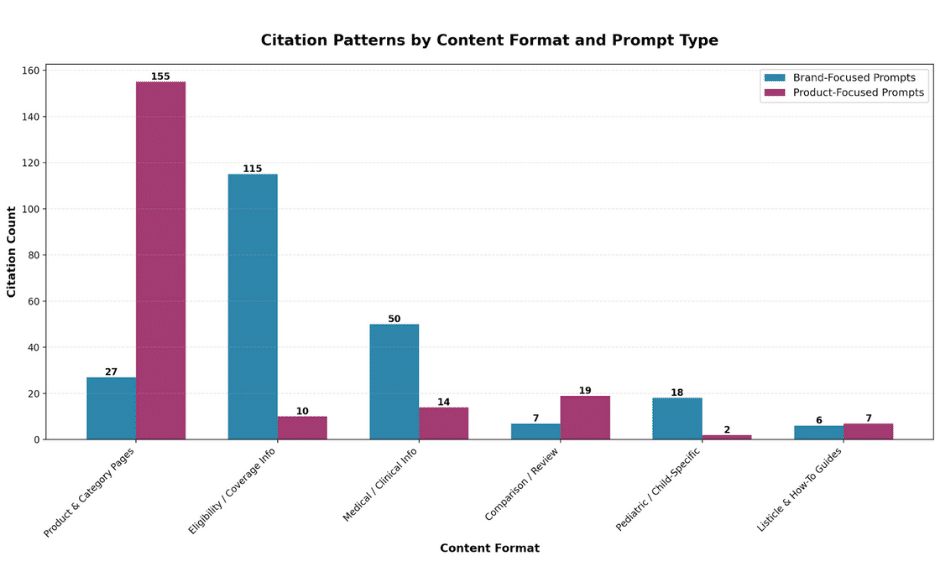
Your content strategy needs to match the query type. In this case, technical, highly authority-driven content for coverage and eligibility, and structured, product-focused content for specifications and comparisons.
c. Content format identification: Classify pages by format: listicles, how-to guides, product pages, comparison articles, tutorials, FAQ content, and case studies. Visualize which formats dominate each prompt type.
This is where patterns emerge. In the SMS marketing niche, the majority of citations from commercial prompts went to “best of” listicles, while far fewer went to product or feature pages. This is a clear sign for content strategy and outreach—best-of lists, comparison guides, alternative roundups, and “versus” articles should be prioritized.
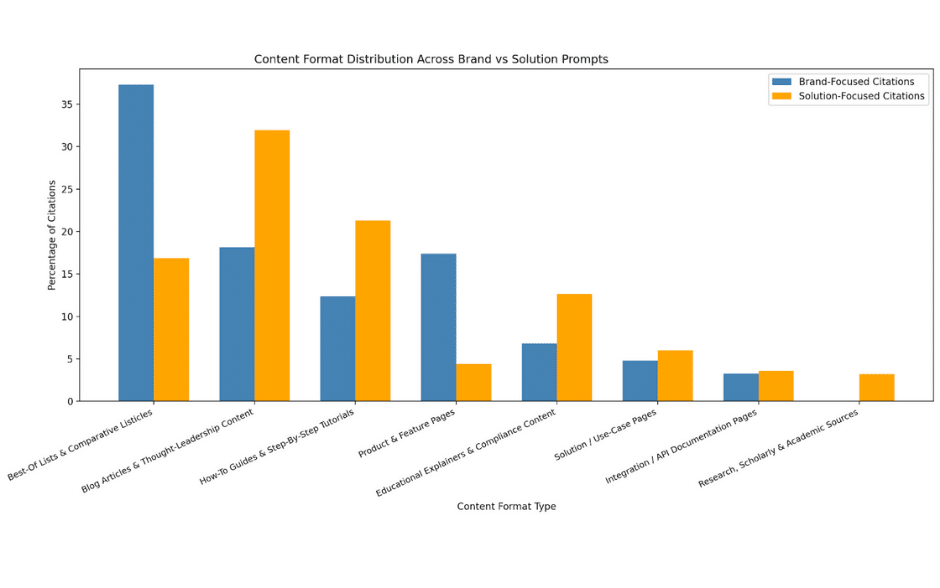
For informational prompts, the majority of citations went to how-to guides and step-by-step tutorials. This was a signal to write highly practical, easily scannable content, enriched with multimedia.
Format determined visibility alongside domain authority.
What the Data Reveals About Authority
Analysis will show how ChatGPT determines authority in your specific category.
You’ll see which content formats get cited most for different query types. Sometimes listicles win. Sometimes technical documentation wins. Sometimes, case studies win. It depends on your category.
You’ll see which ecosystem players control visibility and where gaps exist. In one industry, articles with detailed technical specifications might get cited 4x more than pages with beginner-friendly guides. In another, pages with brand comparison tables might get cited 3x more than high-level product overviews.
The data shows you exactly what ChatGPT values in your space.
Now you can use this data to create content that will quickly help you improve your AI visibility.
Off-Site Strategy: Get Featured Where ChatGPT Already Looks
When we analyzed business texting prompts, ChatGPT consistently cited high-authority publications like Forbes Advisor, G2, Zapier, CyberNews, and Research.com.
These weren’t random. ChatGPT had learned to trust these sources for these categories. The fastest path to visibility is getting featured on the sites ChatGPT already cited, not building domain authority from scratch.
If you want to use this strategy for your brand, first identify the review sites and industry publications ChatGPT cites in your category. Next, prepare materials adapted to each site’s format and editorial angle. Make it easy for editors to feature you.
For competitor-published comparison articles, pursue reciprocal placements instead of one-way requests, and offer to feature them in exchange for inclusion.
On-Site Strategy: Build Content LLMs Can Parse and Cite
Your citation analysis should show you exactly which content structures work in your category. Once you know which formats ChatGPT cites most, and why, you can systematically rebuild your content to match those patterns.
Apply the patterns your data reveals, for example:
- Add contextual scenarios: If cited pages connect products to specific use cases, add those scenarios to your content. Show real users solving real problems in specific industries.
- Structure information for scanning: If tables and structured lists get cited frequently, build more of them. Make it easy for LLMs to extract clear relationships between concepts.
- Document implementations: If competitors with strong citation frequency have detailed case studies, those case studies strengthen their authority for niche-specific prompts. Build your own with operational context, specific challenges, implementation approaches, and measurable results.
- Add persona-based journeys: If cited pages include workflows tailored to specific user types, create persona journeys that show how different roles or industries use your product to solve their unique problems.
- Match the format to the intent: If product pages dominate citations, strengthen yours with technical depth and clear use cases. If how-to guides dominate, build more tutorials.
The key to success is letting the data guide your content strategy. What works in one industry doesn’t work in another. What works for one prompt category doesn’t work for the other.
Keep Measuring What Works for ChatGPT Citations
To stay in the know of changes, keep running the same prompt set quarterly. Track your citation frequency, competitor positions, and format performance over time.
The measurement shows what’s working, where new opportunities emerge, and how ChatGPT’s citation preferences evolve in your category.
Improve Your AI Visibility Starting Today
You don’t need to analyze your entire market at once. I suggest you start with a few high-priority categories, your core product line, your most competitive segment, or the area where you’re losing visibility to competitors.
Use Julius.ai to cluster domains by source type, visualize format performance, and identify competitive gaps: it handles the pattern recognition so you can focus on strategy.
The process is straightforward: build prompts, extract citations, analyze patterns, rebuild content, and build mentions.
And here’s the best news: Most brands won’t do this. They’ll keep optimizing for Google alone, while their customers increasingly ask ChatGPT for answers. This is where you will have an opportunity to advance ahead of the competition.
The earlier you establish citation visibility, the harder it becomes for competitors to displace you.
See where you stand, then close the gap.

Mladen Krstovic is an SEO analyst at Fire&Spark, specializing in AI-driven search visibility, technical SEO, and content systems.