Table of Contents
Key Takeaways
- If you’re a healthcare provider (anyone who sells a service or product, rather than simply publish content)—as opposed to a publisher—organic marketing is still every bit as valuable for patient acquisition despite the emergence of AI search.
- The strategies to gain visibility in AI search are similar to traditional SEO.
- The important changes aren’t in the AI search tech, but rather in how patients are adopting these tools; map your new AI-powered patient journeys to determine where to focus efforts.
- Going forward, invest in best-in-class content targeting subjects with conversion intent, and carefully manage your brand presence & sentiment across the web.
The state of AI search in digital health
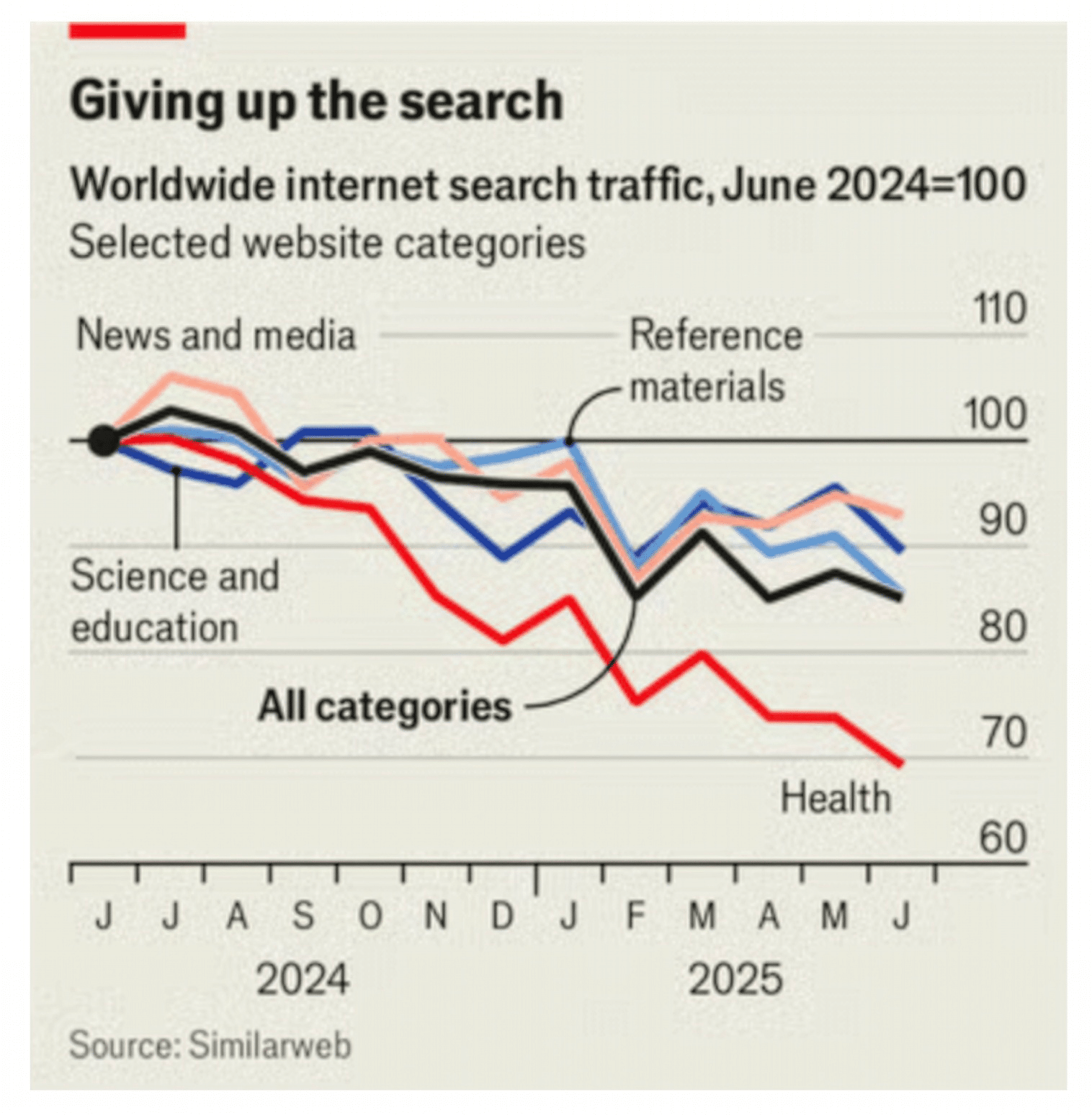
Earlier this summer, The Economist published a breakdown of organic traffic loss by industry.
The eye-catching headline: Healthcare is suffering more than any other field, experiencing traffic drops nearly twice as steep as retail and financial services.
As is often the case in the era of AI search disruption, the story is more complicated (and less apocalyptic) than these anxiety-inducing headlines (“AI is killing the web.”) suggest.
To get a clearer picture of how AI search is affecting healthcare sites, we assessed the Analytics data we have available to us.
We focused on roughly a dozen consumer and B2B digital health brands that we felt would provide an adequate cross-section of the industry (different verticals, sizes, etc.). From there, we aggregated and analyzed the data. Our research design emphasized depth over breadth; we sought to minimize noise and focus on brands with analytics implementations we knew we could trust, rather than include a larger number of sites with unreliable data that may skew the accuracy of our findings.
- Segments: Consumer telehealth platforms, Counseling/mental health services, In-person/hybrid clinics, Digital pharmacy providers, Healthcare SaaS platforms, Health IT consultancies
- Conversion Goals: Patient growth, Lead generation, Appointment scheduling, E-commerce transactions, Software trials, Enterprise lead capture
- Conversion Actions: Intake forms, Online purchases, Web inquiries, Clinic form submissions, Demo/trial signups, Pardot/HubSpot-style automation forms
- Metrics Tracked: Organic traffic, LLM traffic, Click-through rate (CTR) from search results, Conversion events tied to primary business goals
The organic traffic for these sites shows a similar downward trend to The Economist’s graph above.
And below, you will find the average organic/LLM metrics across these sites year-over-year.
YoY change in key organic metrics for July 2025
Average organic traffic decrease for brands in our study
A few key data points from the data above:
This tells a simple story:
AI search is hurting healthcare publishers, not providers
Takeaway
If you’re a provider (defined, for our purposes, as anyone who sells a service or product)—as opposed to a publisher—organic marketing is still every bit as valuable for patient acquisition despite the emergence of AI search.
While a significant amount of organic traffic/click-throughs have been sucked up by AI overviews and LLMs, searchers with conversion intent are still using organic search to navigate to websites to take conversion actions.
Takeaway
More than ever before, it’s vital to focus on conversions rather than traffic as your primary organic marketing KPI.
Enter your email to receive the full dataset of SEO performance for 400+ telehealth brands.
How is AI search impacting site performance today?
The effects of AI search are already here in the form of declines in organic traffic. Setting aside all the clamor of SearchGPT and AI mode and Perplexity’s latest (seemingly weekly) update, the greatest impact on SEO as of July 2025 is the zero-click search impact of features like Google’s AI overviews.
The graph below shows the effect of AI overviews on a site that relied on organic search for traffic growth. Although it wasn’t a publisher in the conventional sense, its growth strategy centered on drawing in large volumes of top-of-funnel traffic and nurturing those visitors until they converted.
Without losing rankings, they were pushed down in the search engine results page (SERPs) for thousands of keywords, click-through rates dropped, and their traffic plummeted along with it.
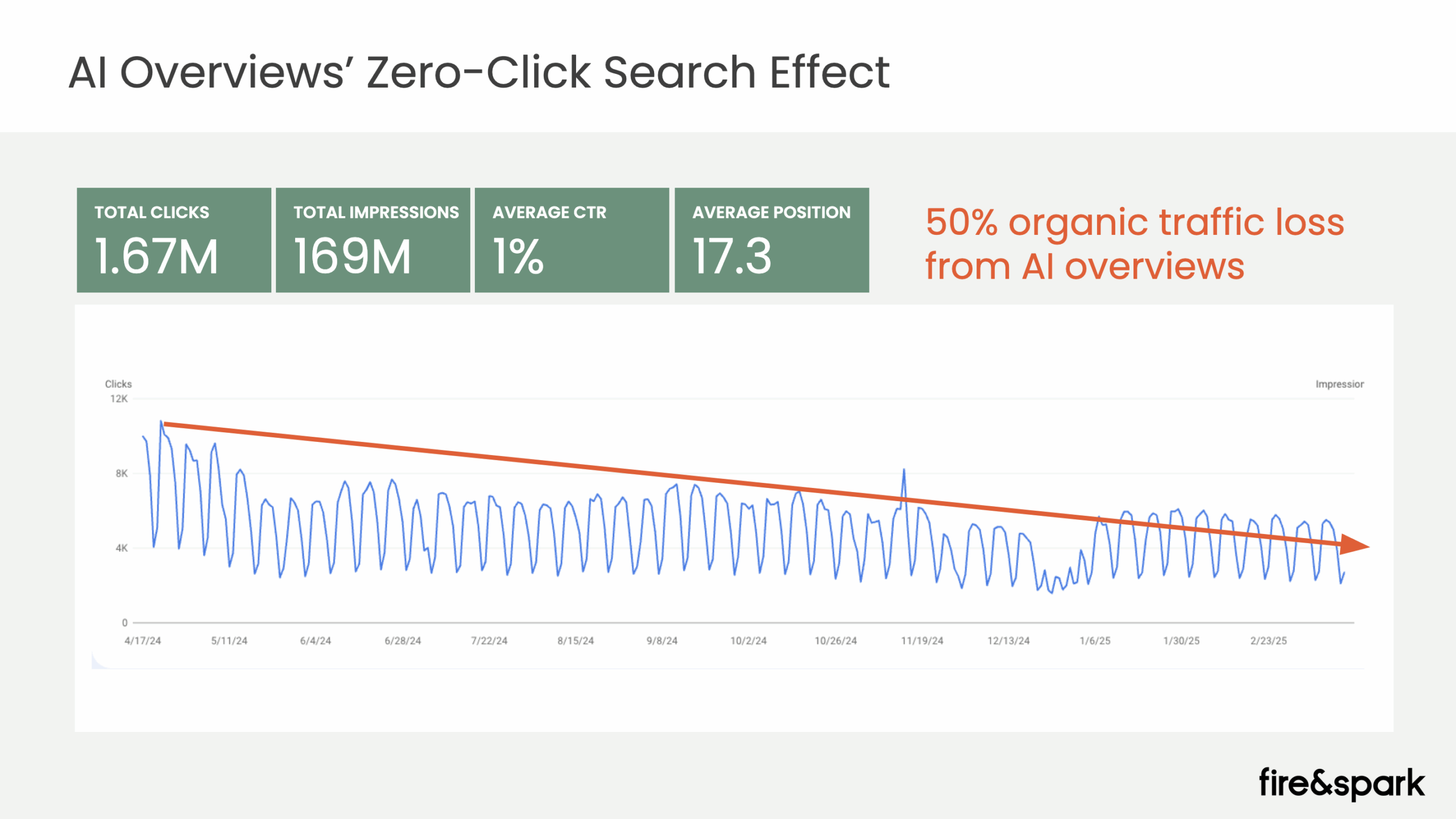
This story exposes the risks of overly relying on organic traffic in the age of AI search.
Marketers who are looking for conversions, not ad or affiliate revenue, should treat organic traffic as one of many leading indicators, while keeping their eye on the real prize: conversions—be it patient enrollments, online sales, or contracts signed.
As of summer 2025, there is a dearth of strong data regarding AI search usage. Platforms like ChatGPT are eager to hype up adoption of their tools.
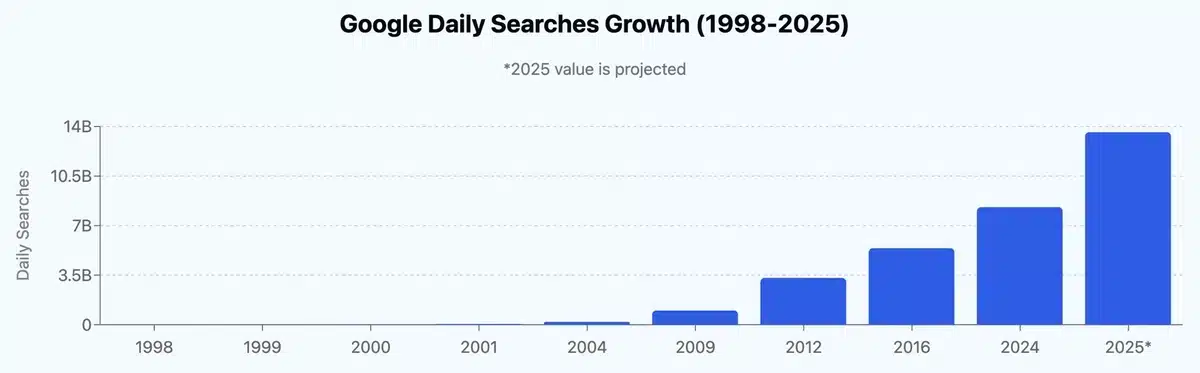
Some studies show rapid adoption of Google’s AI overviews and AI mode, and while the zero-click search impact is at this point undeniable (though its bottom-line impact depends largely on whether you’re a publisher or provider), many studies undercut the “everyone is moving to AI search narrative” by noting continued growth of Google searches.
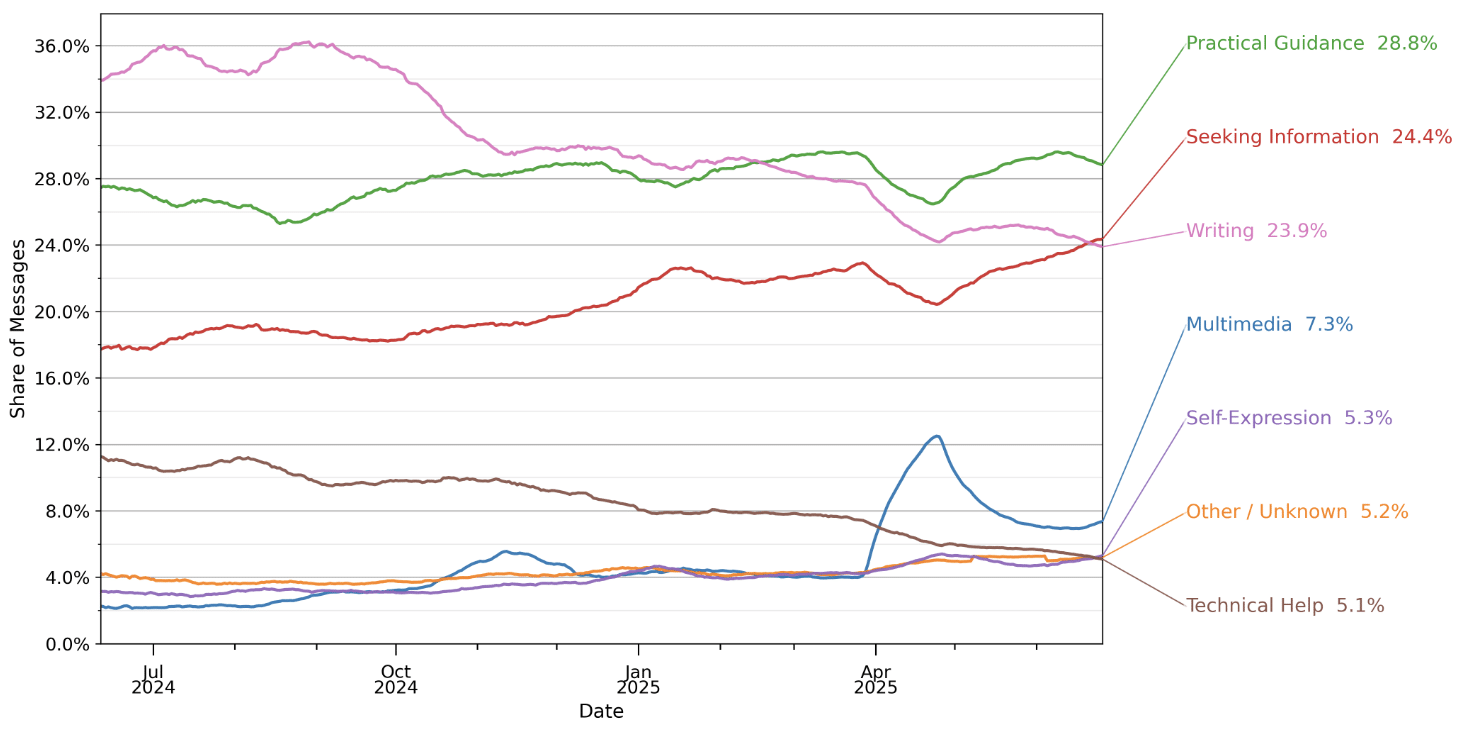
Another interesting recent report on how the public uses ChatGPT has shed some interesting light on changing search behavior within the app. According to the report:
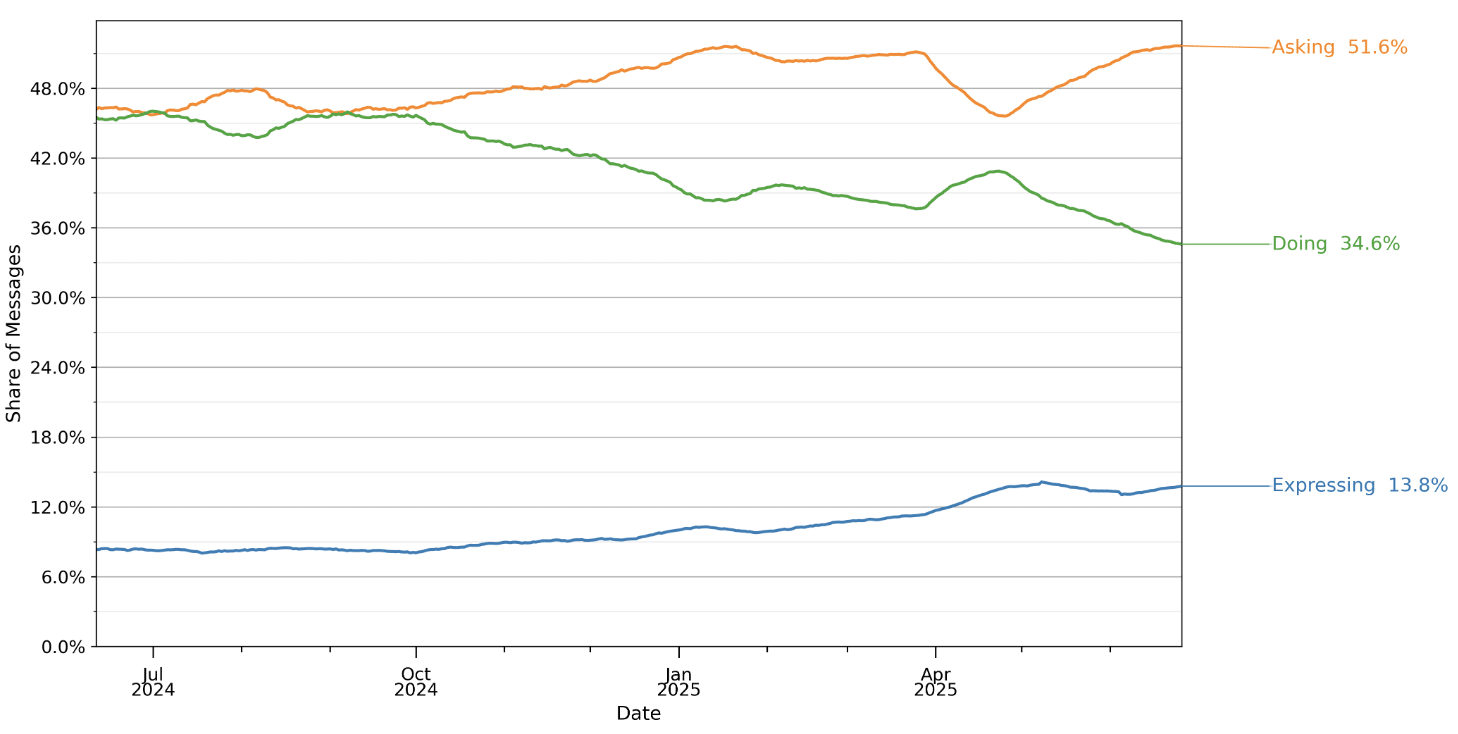
“Writing has declined from 36% of all usage in July 2024 to 24% a year later. Seeking Information has grown from 14% to 24% of all usage over the same period.”
This could indicate broader adoption of the platform as a traditional search replacement, as opposed to a useful gadget/tool, as it was most often used when it first emerged on the scene.
The graph to the right shows how queries classified as “Doing” queries (meaning the user is intending to take an action) have actually decreased as a share of total queries over time, supporting our findings (later in this piece) about LLMs still being used to take a conversion action relatively rarely when compared to traditional organic search.
For marketers, it feels nearly impossible to separate the signal from the noise. Which study do you believe? How should you rethink your search marketing strategy based on what’s happening today—and what’s likely to happen tomorrow?
To get clearer answers, we assessed the Analytics data available to us. Below are our key findings from our analysis of a dozen digital health sites.
What our data tells us about the impact of AI search on digital health marketing
Learning 1: It’s a great time to be a healthcare provider (but not a publisher)
As discussed above, increased conversion rates are compensating for lower organic traffic, meaning that there is no data to indicate that digital health marketers should reduce their expectations for SEO as a channel.
YoY change in conversion rate key organic metrics for July 2025
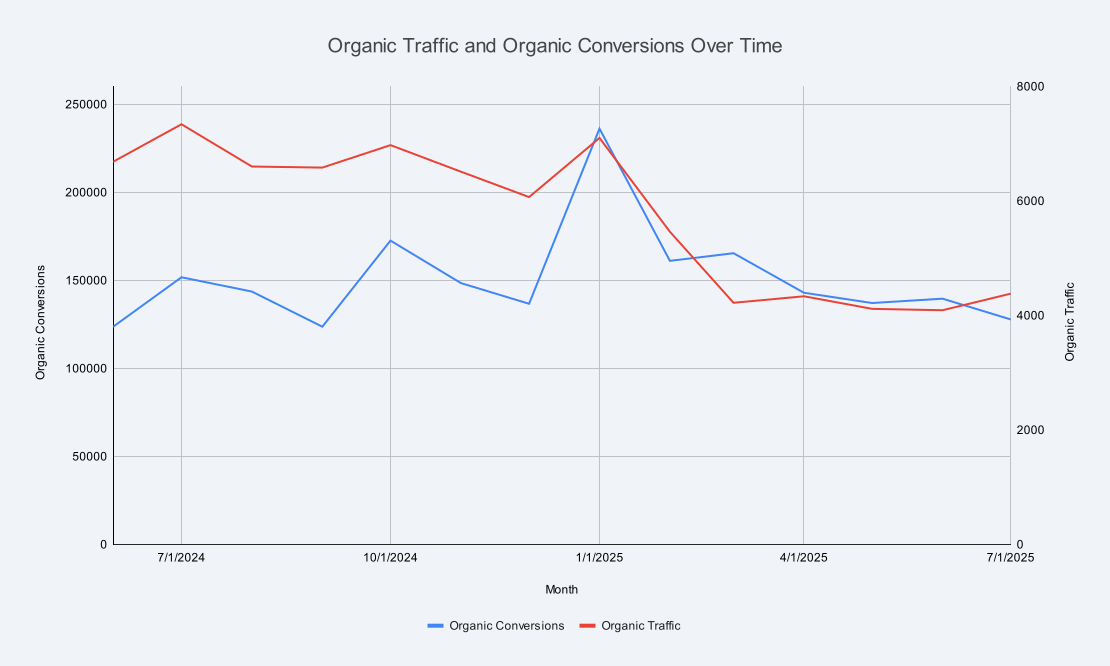
The shrinking of the gap between the red and blue line entering 2025 shows conversion rates increasing as low-quality traffic declines.
Learning 2: LLM traffic is growing quickly (but is currently miniscule compared to traditional SEO)
The graph above shows the average number of monthly site visitors being referred to each site from various LLMs according to GA4 data.
In July of 2025, the average LLM traffic to this set of sites was 123, just 0.8% of the 15,000 visitors these sites are seeing on average from traditional search engines. However, the curve is exponential.
Takeaway
To get ahead of the rapidly growing adoption of AI search, start integrating GEO into your organic marketing approach today.
“But,” you may be thinking, “we expect fewer click-throughs from LLMs. How about conversions?”
Learning 3: LLM traffic is converting at a higher rate than traditional organic traffic, but the gap is closing
As of July 2025, conversion rates from LLM traffic reached 4.3%, compared to 2.8% from traditional organic search—more than 1.5 times higher.
Average YoY change in conversion rate for July 2025
While there is some noise in this data (an inability to filter out branded search, etc.), it seems apparent that traffic from LLMs is converting at a notably higher rate—just not high enough to balance out the fact that sites are receiving roughly 1/100th of their organic traffic from LLMs.
We’re also seeing the LLM conversion rate decline over time, from 5.5% last July to 4.3% this July. Is that due to a small sample size? Or an actual trend to read into?
The answer is likely somewhere in between. Our educated guess is that LLM traffic is heavily biased by “sophisticated” users—early adopters who are intentionally integrating LLMs into their decision-making process to test out these tools.
As more “casual” users adopt these platforms, we would expect conversion rates to drop as more “everyday people” (rather than marketers or tech nerds) use AI search tools to find solutions. Our suspicion is that these “casual” users will not convert at the same rate due to a lower level of engagement with the suggestions LLMs provide.
Additionally, the line between “traditional search” and “AI search” is blurring. As Google continues to roll out AI Mode, it makes sense that the ways searchers interact with Google search and, say, ChatGPT, continue to converge.
With all that being said, some of that shift may prove to just be the result of a relatively small data set, and we will be able to get a clearer picture over time.
Takeaway
Expect higher conversion rates from organic and LLM traffic going forward to balance out declining site visitors.
What is GEO?
Generative Engine Optimization (GEO) is the next evolution of Search Engine Optimization (SEO). Historically, the job of the SEO strategist has been to influence the ranking algorithm of search engines (namely Google) so that their own site is shown at or near the top of the search results page for the keywords their target is audience is searching.
Now, keywords are becoming secondary to search intents. Instead of typing in three word phrases to find pages with the information they’re looking for, searchers are typing in long, detailed prompts and expecting to receive much of the information they’re seeking on the results page itself. Furthermore, when they don’t find exactly what they’re looking for, they respond to the LLM to refine their request; in this way, search is becoming conversational.
Is GEO still worth investing in?
Generative Engine Optimization is still in its early stages, which makes it particularly difficult to execute effectively. Whereas SEO strategies have been refined over decades with (mostly) well-understood rules and ranking signals, GEO targets rapidly evolving AI search platforms with far less predictability. Despite these challenges, GEO offers a compelling upside:
- Higher intent traffic: As evidenced by the data above, users who click through from AI-generated answers are often further along in their decision-making process. AI systems have already synthesized context for them, so by the time they get to your website, they are informed and getting ready to convert.
- Stronger brand visibility: GEO helps ensure your brand appears accurately and authoritatively in AI responses, especially critical when AI answers might otherwise hallucinate or misrepresent information
- Control over AI narratives: GEO gives marketers the tools to influence how their brand is perceived by AI, rather than letting AI tools pull unflattering details about your brand from across the web uninhibited.
While ranking for relevant searches is still the name of the game, two things have changed: 1) the term “search engines” have expanded to mean “any platform where your audience searches for information”, not just a page where a searcher is presented with 10 blue links in response to their query and 2) “keywords” have expanded to include prompts entered into LLMs, as well.
LLMs and search engines still assess which content to show for various user searches/prompts in similar ways:
- They crawl your site and assess what searches/prompts your content is relevant to satisfy.
- What subject matter do you discuss?
- Does your content satisfy the intent of the searcher?
- Is your content of high quality?
- They assess how trustworthy your organization and content are.
- Is your content written by—or alongside—a real human with real expertise, a unique perspective, etc.?
- Is your content/website cited by other trusted entities on the web?
- Does your organization/team have demonstrable real-world affiliations, proven authority, positive brand sentiment in relevant sources, and other bona fides?
For the next evolution of authority-building, online mentions and coverage matter. Backlinks are still valuable insofar as they provide evidence that your brand is legitimate and known, but in the GEO era, it’s better to think of a backlink more as a real-world trust signal than a technical “hack” exploiting the ranking algorithm. In other words, quality over quantity.
Per Tim Worstell, chief of digital strategy at marketing firm Adogy, in Intelligencer:
Chatbots, some consultants say, interpret content more like a person than Google’s ranking algorithm does, meaning that they can be influenced in the approximate manner of a skimming human being. “The more PR you can get out there,” Worstell says, “you’re creating a bias. Now you’re on these sites, and that’s where all these LLMs are crawling. And the LLMs are like, This must be something.”
Takeaway
Rather than throw money at backlinks and building domain authority, invest in PR and online community engagement that secures positive recognition on platforms your audience actually trusts online.
How do LLMs assess and cite content?
On a technical level, the specifics of how LLMs perform these assessments do differ. However, at the end of the day, the way SEOs influence LLMs is largely similar to how SEOs have influenced search engine ranking algorithms for decades—with a few key differences.
(Warning: nerdy stuff ahead)
According to GEO specialist and Fire&Spark founder, Dale Bertrand:
“The shift from SEO to GEO represents a fundamental change in how brands approach search optimization. GEO is harder and less reliable than traditional SEO because it targets complex, stochastic, and rapidly evolving AI search platforms. So results are less predictable than traditional keyword-based ranking signals. However, GEO will be critical because GEO traffic converts better than traditional SEO traffic. Visitors arriving from AI-generated answers have higher intent since the AI has already synthesized the information for them. So they are further along in the decision-making process when they land on your website.”
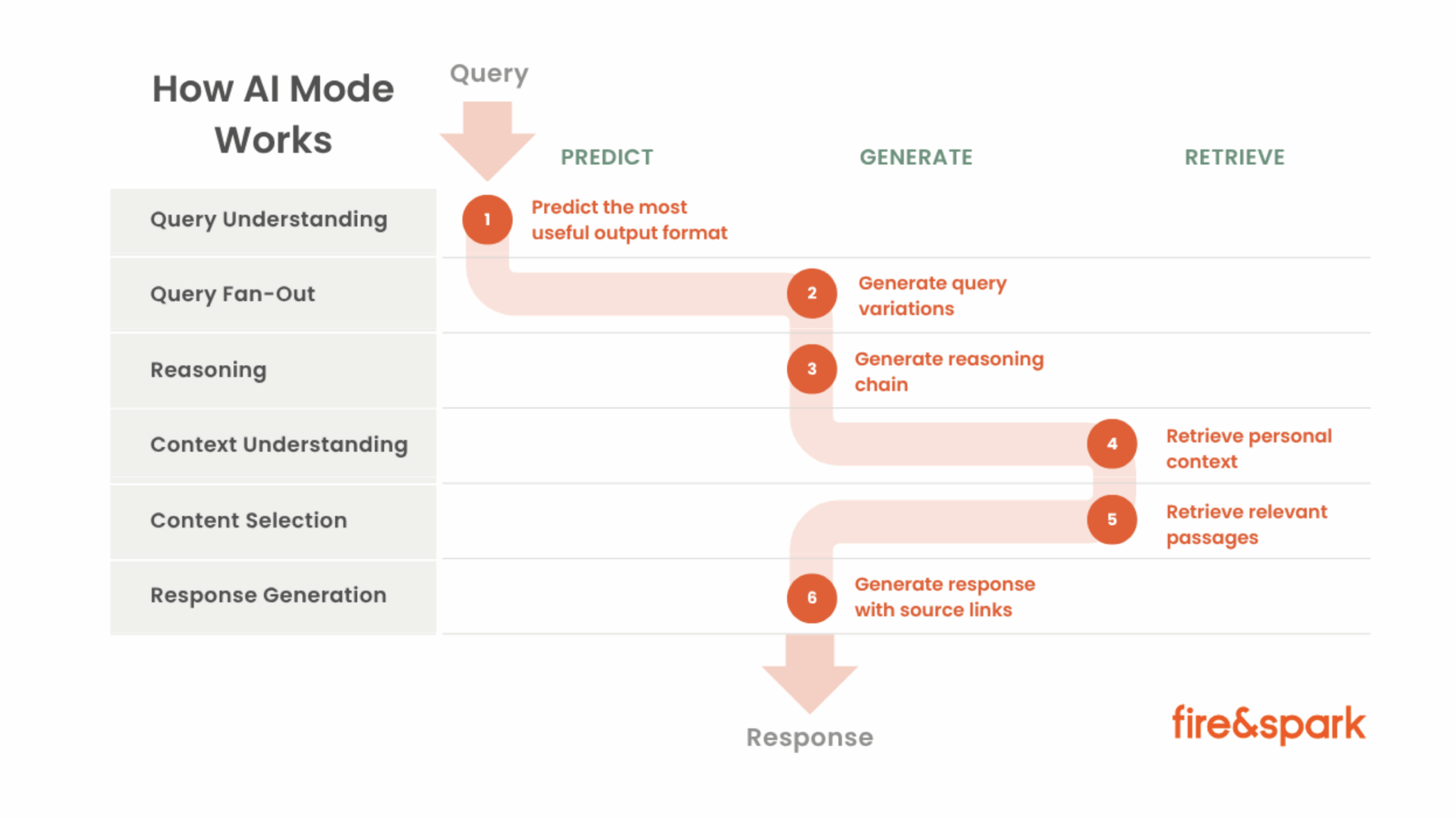
While traditional technical SEO elements remain important, GEO success is fundamentally about content strategy rather than technical optimization. The focus should shift away from technical optimizations toward ensuring content is semantically rich and comprehensive rather than relying heavily on schema or structured data alone. With that said, there is some evidence that AI benefits from schema markup even though it doesn’t parse it directly. AI simply sees the schema markup as a semantically significant structure in the document.
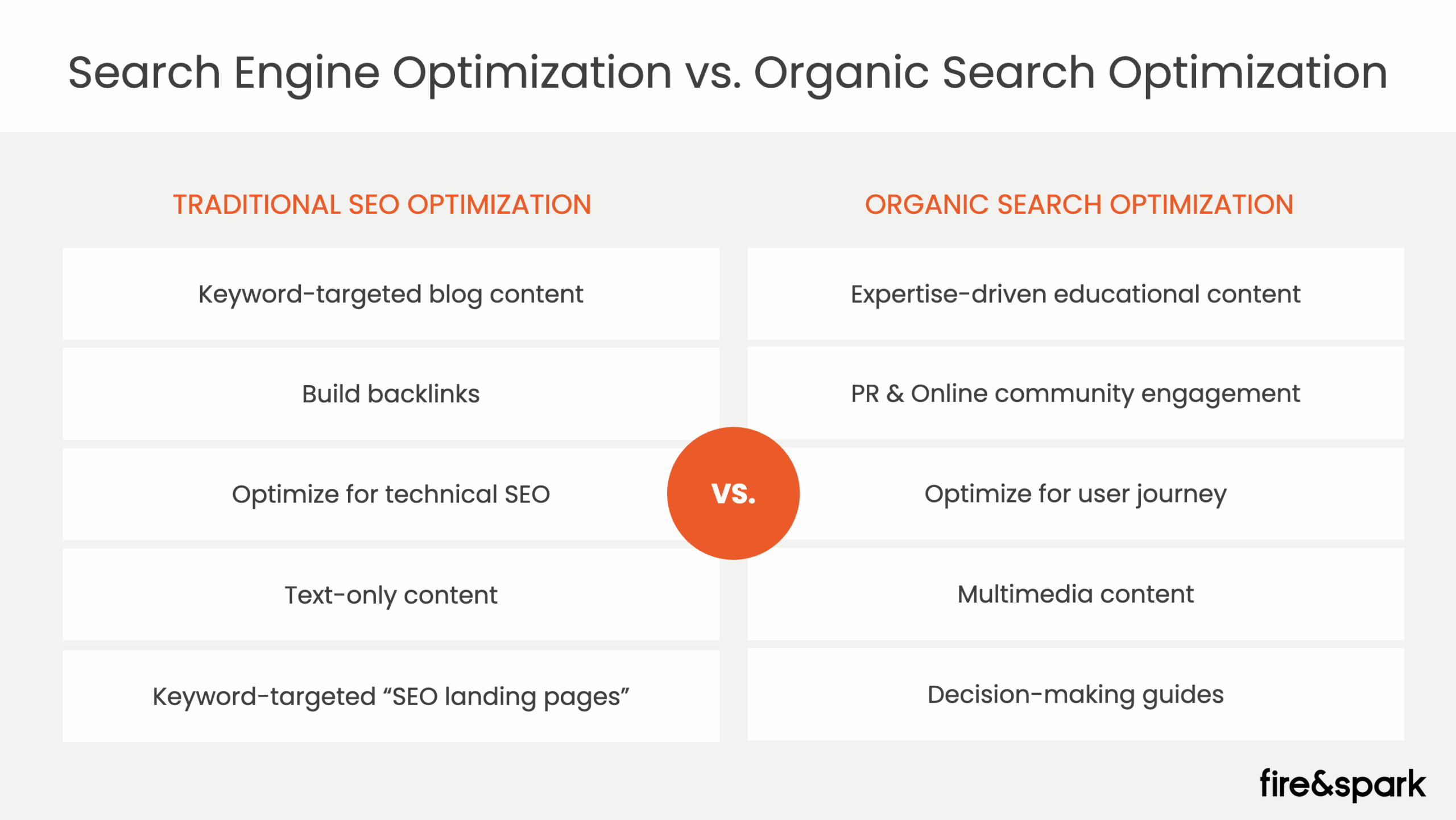
The table below illustrates Fire&Spark’s internal methodology for the shift from SEO to GEO.
Digital Health GEO Case Study
To make these lessons concrete, here is a case study that looks at what matters most: how our patients and customers are using AI.
For this example, we track a sample patient’s journey through Google AI mode, beginning at the top of the funnel, as they discover solutions for their “pain point”: in this case, depression.
Top-of-Funnel Prompt Example
LLMs are conversational, meaning that their goal is to have a dialogue with the user which ultimately guides them from problem to solution. The user searching “why am i feeling tired all the time, sad, can’t focus?” likely doesn’t have a diagnosis, and may not even believe themselves to have any sort of mental health disorder.
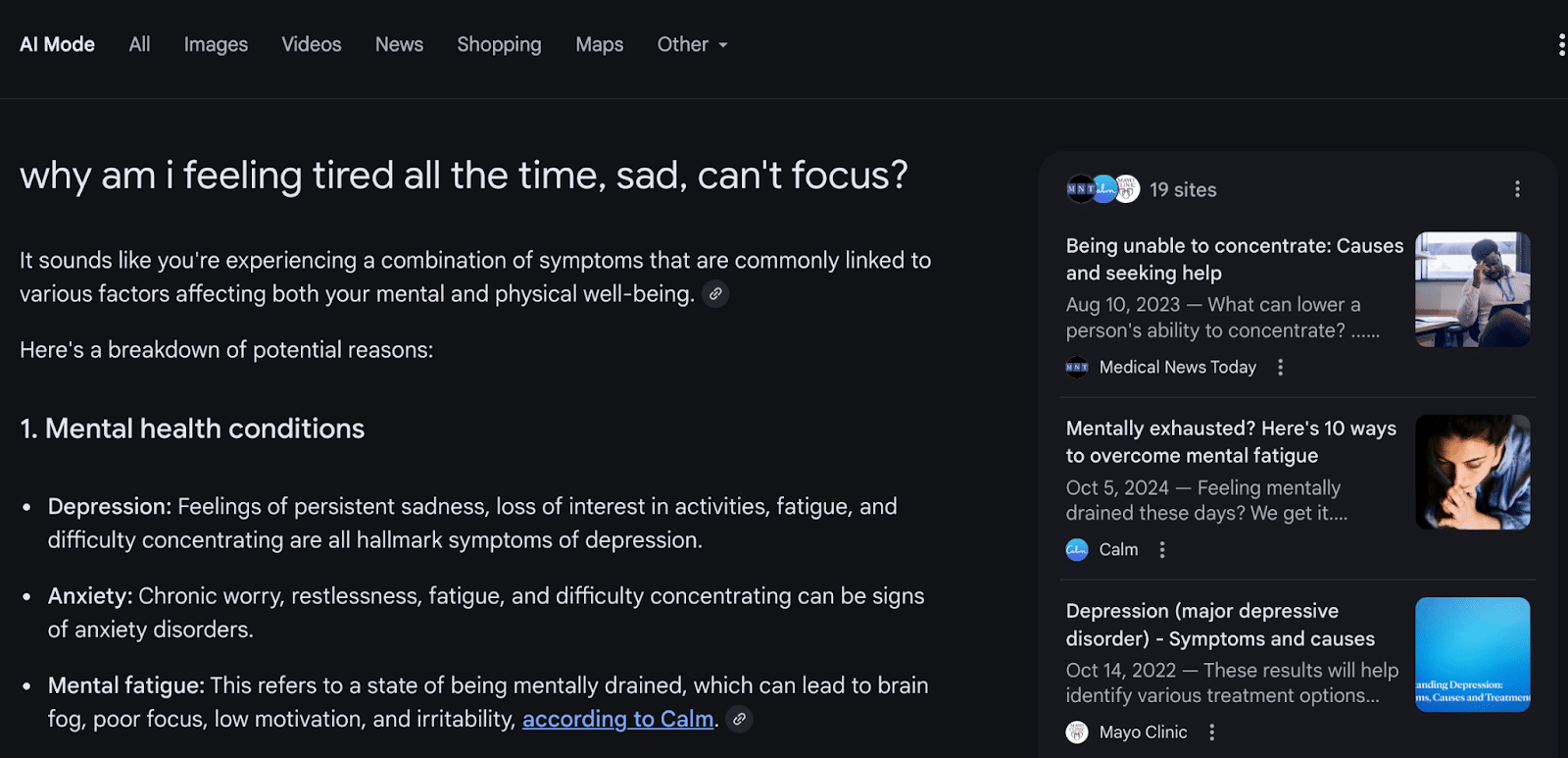
When entering a very top-of-funnel or informational prompt into AI mode, the user is presented with a vague, generic response. In this case, AI mode is trying to provide the most widely applicable information—and to do so, they are citing some of the largest, most trusted sources in the healthcare space: Medical News Today, Calm, and Mayo Clinic.
To someone wondering, “How can I optimize my content to get shown in this response?”, I would say, “You’re asking the wrong question.”
Takeaway:
When moving from SEO to GEO, it’s critical to ask, “Is this response worth optimizing for?”
In this case, I would argue that the answer is “No,” for 99% of sites for three reasons:
- 🔴 Stiff competition
-
- massive, established players being cited (Medical News Today, Calm, and Mayo Clinic)
-
- 🔴 Low chance of click-through
-
- prompt is fairly well satisfied by the AI summary
-
- 🔴 Low chance of conversion
-
- Very little conversion-readiness associated with this prompt
-
Throwing resources at addressing this search intent with your content is unlikely to land you in a top citation spot for prompts like this. However, if you provide, say, treatment for depression, you may still want to create this content—but the goal isn’t to get cited, but rather to train the LLMs on your domain of expertise.
Mid-Funnel Prompt Example
Here’s an interesting response to the follow-up prompt searched by our imaginary patient: “should i stop drinking to treat depression?”:
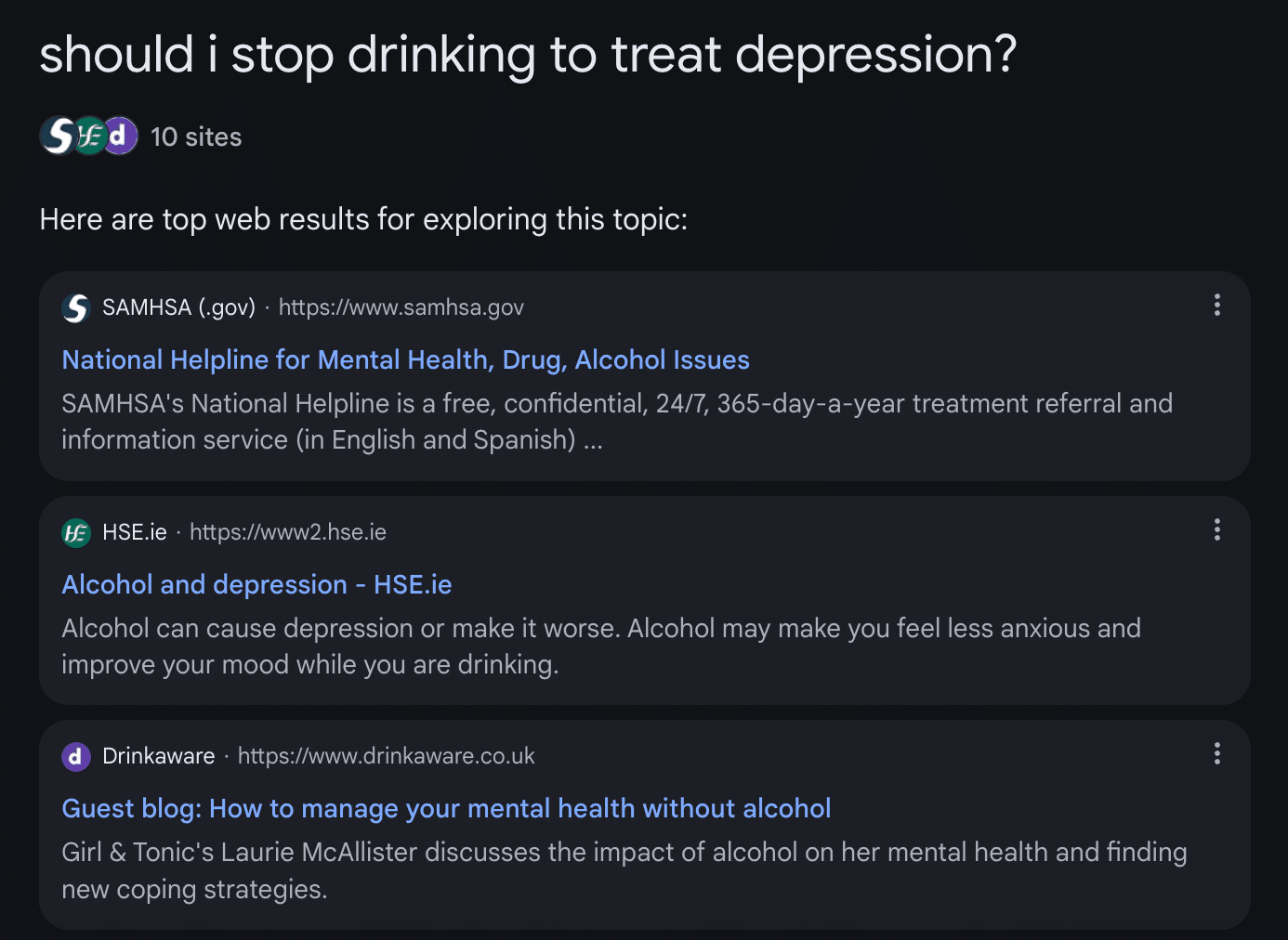
Instead of even trying to satisfy this prompt with a summary, AI mode is simply providing the user with a collection of ten blue links….
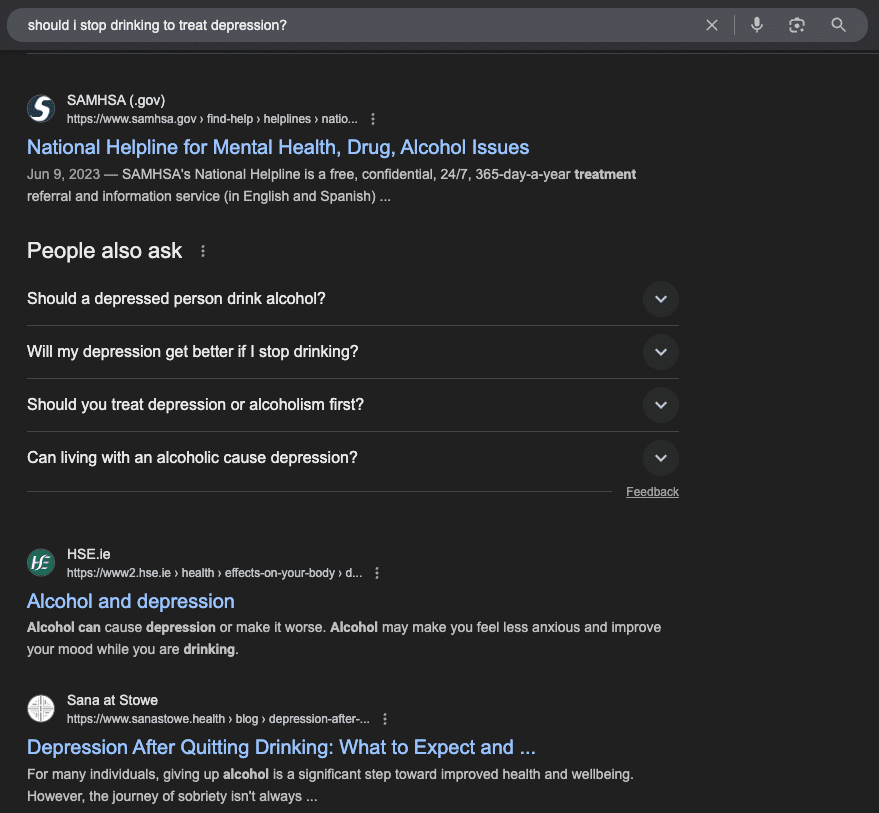
Talk about reinventing the wheel…
In this case, the reference to alcoholism/substance use disorder appears to have triggered AI mode to avoid liability and direct searchers to trusted sources instead of generating a response.
For the brands who are able to adequately address this prompt, they are more likely to get cited prominently for a user who is clearly considering various solutions to their problems. Unlike the top-of-funnel prompt above, getting cited for this prompt provides clearer upside due to:
- 🟡 Relatively low competition
- a greater number of citations, some lesser-known organizations cited (but below large organizations)
- 🟢 High click-through rate (no summary to compete with)
- 🟡 Moderate conversion intent (user farther along in their conversion journey)
I would encourage a brand that treats a combination of depression and alcohol use disorder to invest in getting their content cited for this prompt. (Download our digital health GEO playbook for advice on how to accomplish this.)
For a more standard mid-funnel response, let’s assess what AI mode responds with for the prompt “tms vs cbt for depression”
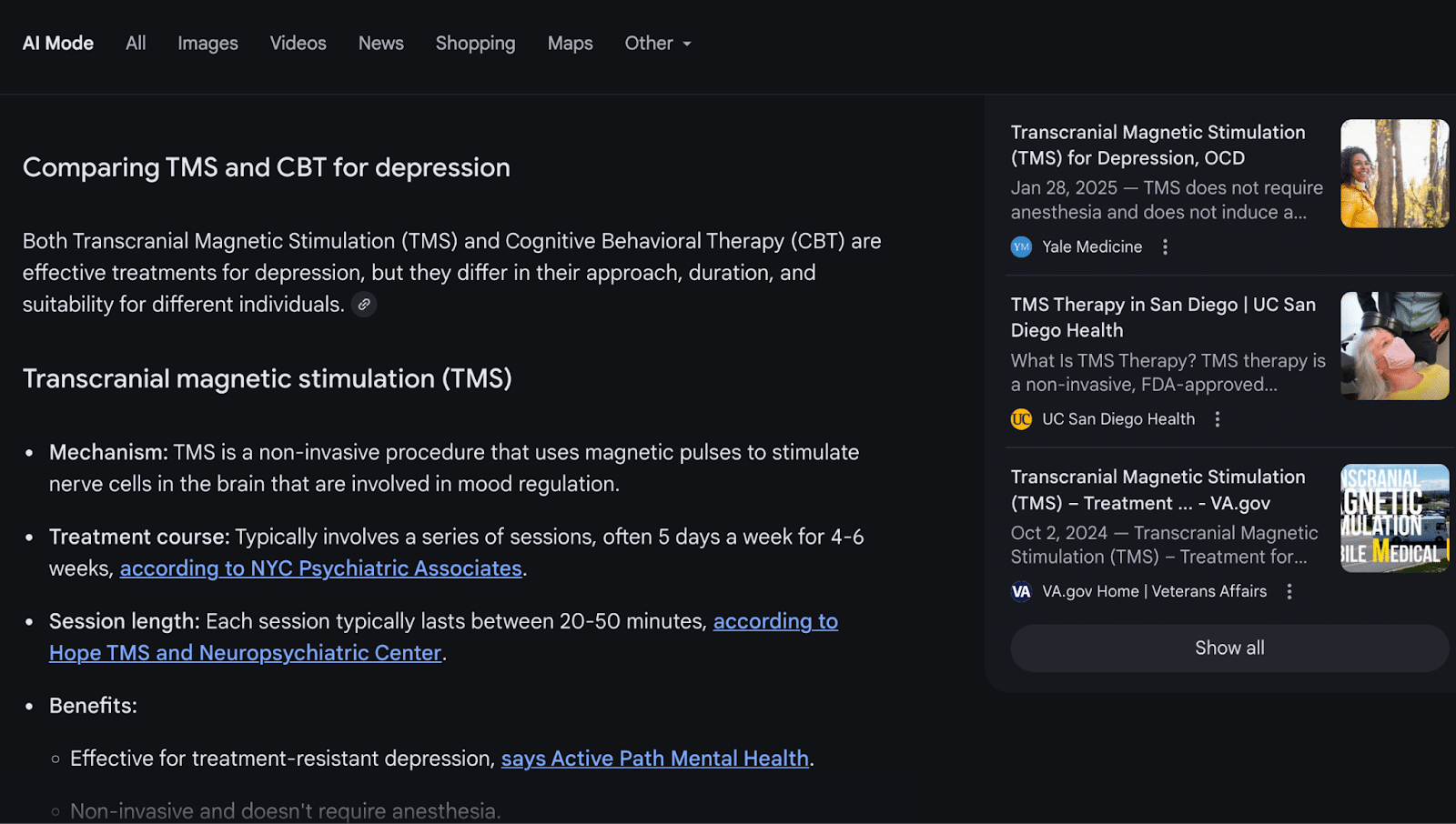
At this stage in the patient’s journey, they have narrowed in on the problem they’re trying to solve (depression) and are currently exploring various options.
Here, three providers are cited above-the-fold within the response:
Looking at one of the cited sources (Hope TMS and Neuropsychiatric Center), it is clear that there is an opportunity to provide better content that more adequately satisfies the prompt.
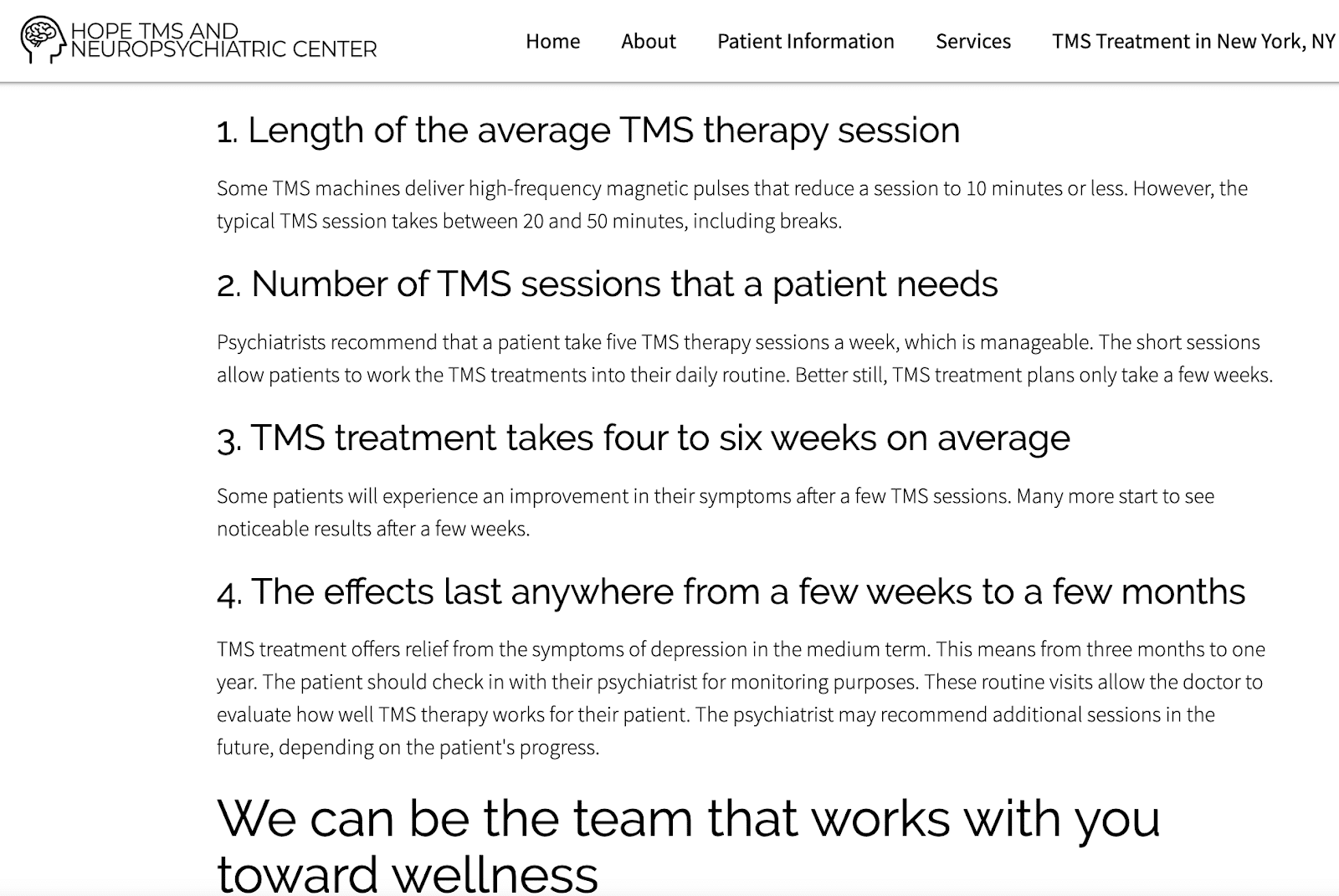
Hope TMS’s content can be beaten with moderate investment in a competing piece.
The competition here is clearly lower than on some of the other prompts we’ve looked at. Specialty mental health providers – rather than large healthcare systems and government organizations—are being cited. That’s a good sign if you, too, are a provider.
- 🟢 Relatively low competition
- providers being cited prominently
- cited content is low quality
- 🟢 High click-through rate
- lower down in search funnel, more likely to check out provider sites
- 🟢 Medium-to-high conversion intent
- user is comparing treatment options
Bottom-Funnel Prompt Example
Here is someone who has done their research and knows what they’re looking for: “best cbt providers in massachusetts blue cross”.
Even as AI search adoption grows, the number of people entering this exact prompt in Google will be exceedingly low due to the specificity. However, if you are a provider of CBT operating in Massachusetts that takes Blue Cross insurance, you’d struggle to find a better prompt to show up for from a conversion perspective.
- 🟢 Relatively low competition
- providers being cited prominently
- exclusively local competitors, not national publishers/major organizations
- 🟢🟢 High click-through rate
- lower down in search funnel, very likely to check out provider sites to convert
- 🟢🟢🟢 Wicked high conversion intent
- user is deciding on their provider for a treatment they know they want to pursue
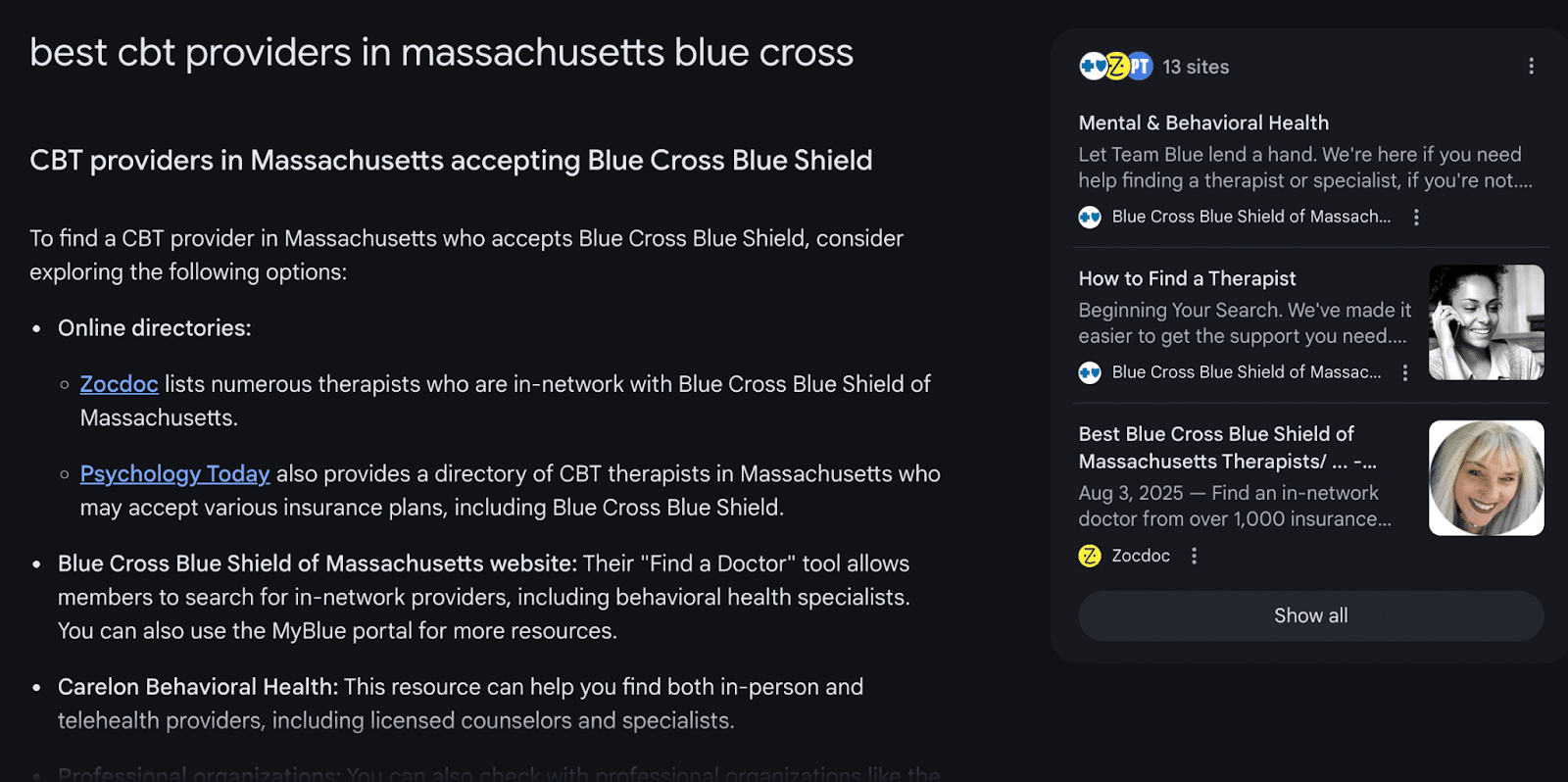
At the top of this response, there’s a short summary providing users with a few venues to find a provider (Zocdoc, Psychology Today, Blue Cross Blue Shield’s website).
Takeaway:
Make sure your providers’ profiles on directories like Psychology Today and Zocdoc are complete and compelling.
Many patients start their search on these directories—or use them alongside Google and LLMs—when looking for care. That means it’s worth investing in high-quality profiles that include friendly headshots, engaging and descriptive bios, quotes, video introductions, and accurate details about insurance, hours, and contact information.
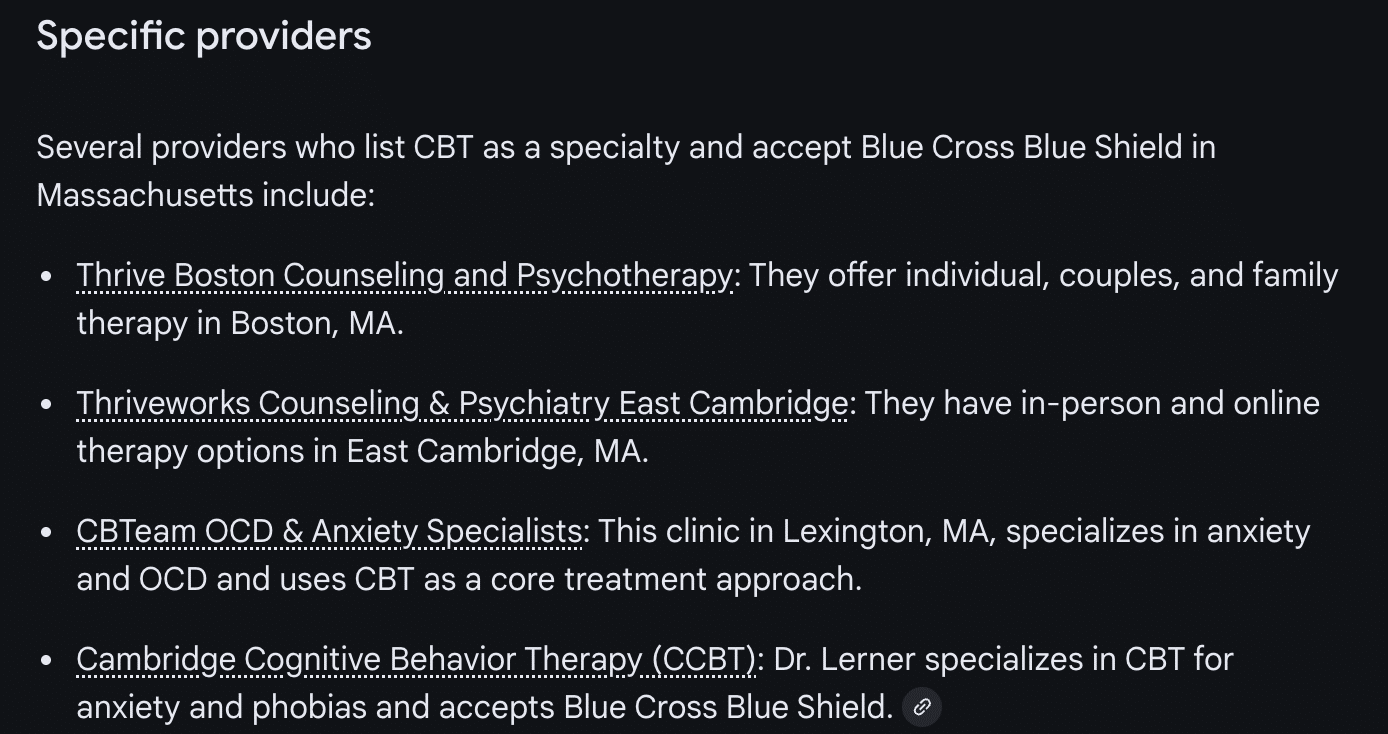
Below the directory recommendations, AI mode begins recommending specific local and telehealth providers.
This essentially provides the same experience as a traditional Search Engine Results Page (SERP), with a bit more information custom to the user’s prompt history:
- Clarifying that they list CBT on their websites
- Clarifying that they list Blue Cross Blue Shield as an accepted insurance on their websites
- Providing a brief, custom-generated summary of their specializations.
Even though my prompt only specified the state (Massachusetts), Google identified that my computer is located outside Boston, and only recommended providers in my immediate area.
Below this list of recommended providers, the user is presented with a more traditional local listing, featuring a map pack with reviews, images, locations, hours, etc.
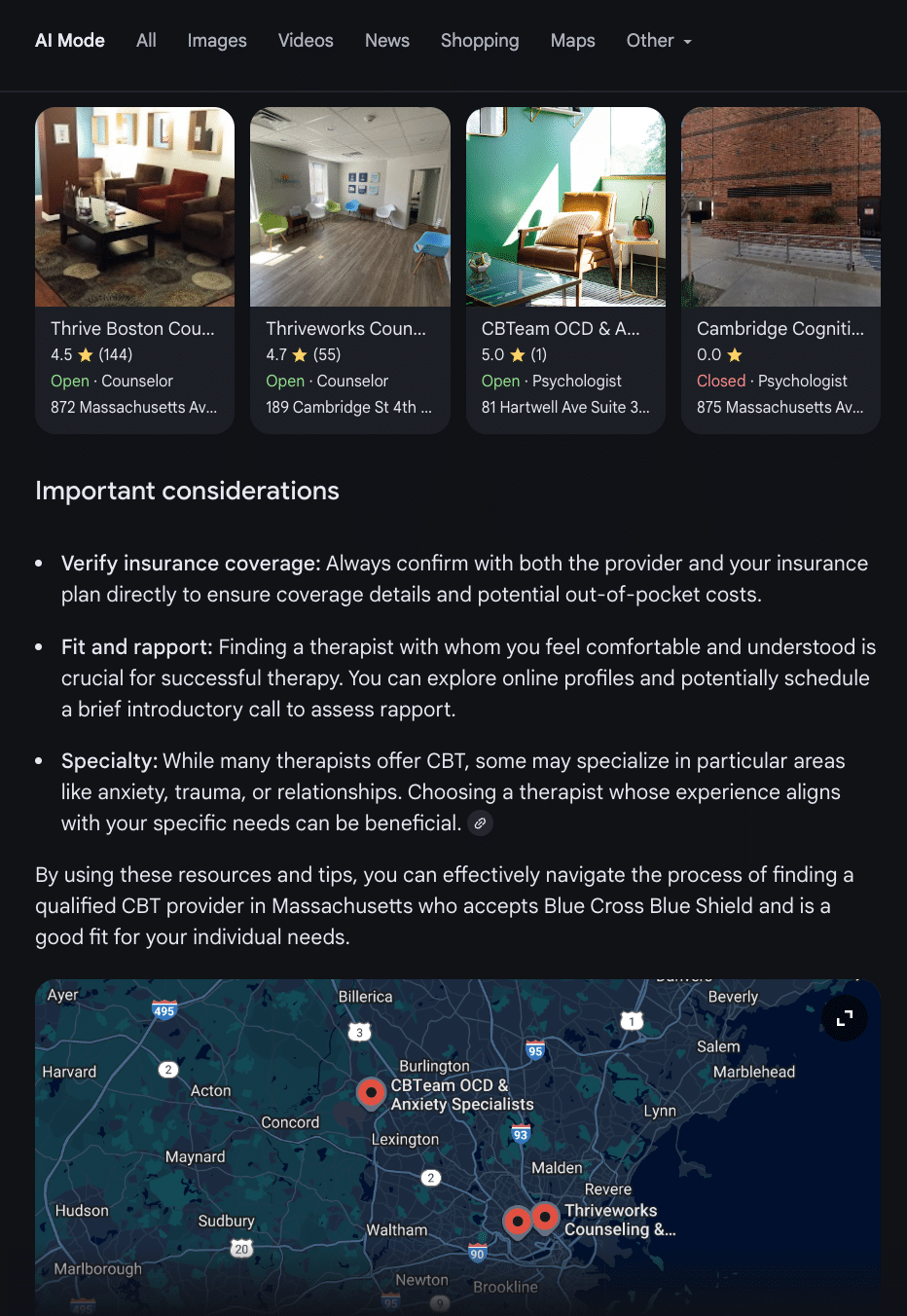
At this point, the experience is quite similar to that of using Google Maps or a traditional local Google search result—with one big caveat:
With AI mode, this experience remains conversational. This means that, from here, the user can ask clarifying questions about the providers to narrow down their search further.
Takeaway
To stay visible in AI-driven search, create content that not only addresses core questions but also explores related topics and provides in-depth coverage that grows more useful as your prospective patient moves down the funnel.
For instance, from here, you could imagine the searcher ensuring that these providers have hours that work for them:
Any providers who aren’t transparent about their hours—or have outdated/inaccurate information on their site—are risking losing potential patients before they even click on a website.
Takeaway
Google’s AI mode will likely replace the traditional Google search experience in the next 9–18 months.
With this in mind, how should digital health marketers rethink their organic strategy to maximize their patient acquisition potential in this new search experience?
Focus on changes in audience search behavior, not changes in search tech
The changes in search platforms new and old seem to be coming out almost daily. There are literally dozens of AI search engines trying to gain a foothold in the space. The largest players are pouring unthinkable sums of money into their AI platforms. How could marketers possibly keep up with all these changes? And how can they pivot their strategy to optimize for everything all at once?
The answer is that they can’t. Perhaps more importantly, they shouldn’t.
If professional search marketers can’t keep track of these tech developments, then their audience can’t either. Instead, their audience will naturally start integrating these new and improved tools into their information-gathering arsenal.
One day, the dust will settle and a handful of tools—perhaps with just one leading tool, e.g. Google with traditional search—will cement their dominance. The best way for marketers to understand what is static and what is noise is to seek and maintain an on-going, deep understanding of their audience’s evolving search behavior.
We recommend simplifying things. Focus on your own data whenever possible. Get benchmarks from other similar brands from our analysis above and other similar studies.
When you come across a study discussing the changing search behavior of searchers on-the-whole, or dissecting market share of various search tools and LLMs, it’s important to focus in on what actually matters.
How everyone is searching is irrelevant; how your audience is searching is what matters.
The digital health audience (a broad category on its own) is vastly different from an audience of B2B IT professionals, just as it is different from an audience of rural-based senior citizens looking for information about upcoming events in their town or county.
B2C telehealth audiences are unlikely to be as savvy as the B2B IT professional but savvier than the rural elderly population.
So, what about your your specific Ideal Customer Profile (ICP)? Where in the funnel are they using AI search tools? For initial research into their condition? For the comparison of provider options at the decision-making stage?
Takeaway
Track how YOUR ideal customer is using AI Search at different stages of their buying process.
A Digital Health GEO Q&A
Question: Is SEO dying?
Answer:
Let’s start here: No, search marketing isn’t dying.
The set of marketing activities that we have referred to as “SEO” for the past 20+ years are evolving—and in some cases, evolving significantly. Call that “dying” if you want, but it’s important to be clear whether you’re referring to the activities or the results.
While there can be a debate about whether standard SEO activities are dying, it is inaccurate to say that the results SEOs seek (business growth via organic search) are going anywhere any time soon.
If SEOs manage the transition well, they will be focusing more on organic conversions as their primary KPI as opposed to organic traffic.
While the activities, KPIs, and tools are changing, our data shows that the organic search channel is just as viable a way to grow your business today as it was five years ago. In fact, the total volume of organic searches is likely to grow as new ways to search (LLM prompts, search functionality within social media platform, voice search, conversations with AI bots, etc.) become more popular.
Question: Should I increase or decrease my investment in SEO/GEO content creation or site optimization?
Answer:
If you’re a brand that relies on conversions to grow your business, rather than traffic, there is very little data currently to support a decision to decrease spend on organic search marketing. Search marketing continues to bring in organic conversions at roughly the same rate as it has historically.
As with any emerging channel, those on the cutting edge—experimenting, testing campaigns, and figuring out what works—will have first-mover advantage as the playbook is determined, and will see mid-term and long-term payoffs.
To state the obvious: If you have determined that you have the budget to increase investment and see the value in being the first-mover in your industry: Go for it.
Of course, not all companies have enough marketing budget to invest in proven strategies, let alone experimental strategies, so here’s what we tell the brands we advise:
Rather than throw money at an untested set of “GEO campaigns” in addition to your SEO campaigns, strategically rethink your current SEO gameplan. Rather than view “GEO” as a whole new channel to layer on top of SEO, think of it as an evolution of your SEO investment; the resources you should put into showing up in AI search tools should grow as the share of search traffic your audience performs within these tools grow. Keep a close eye on how your audience is adopting these tools to anticipate where your investment will be best spent in the months and years ahead.
Question: How can marketers measure the success of GEO efforts?
Answer:
There’s a crucial measurement shift needed in the field: We need to move from traffic metrics to measuring incremental lift. Instead of focusing on top-of-funnel metrics, measure downstream business outcomes. One tactic: Since direct attribution for much AI search traffic remains unresolved, combine quantitative and qualitative tracking by adding open-ended “How did you hear about us?” questions to lead gen forms to gain invaluable customer journey insights.
Question: What are the best tools to measure the current reach of your brand--both in AI overviews on Google and ChatGPT?
Answer:
We’ve been impressed by the capabilities of Peec AI and Profound, which help you measure visibility, citation rates, and sentiment of your brand across AI platforms. AI measurement tools are improving every day, but are still woefully inadequate when compared to major SEO tools like Ahrefs or SEMRush. We expect to see major improvements in these third-party tools—as well as the roll-out of more transparent reporting functionality from the major players themselves (Google, OpenAI, etc.)—over the next year.
At a minimum, you should have a visibility tracker via the API for the most common platforms. Set it up to run a few prompts commonly used by your ICP through LLMs each day and report on whether you and/or your competitors are being referenced. Here’s what our’s look like:
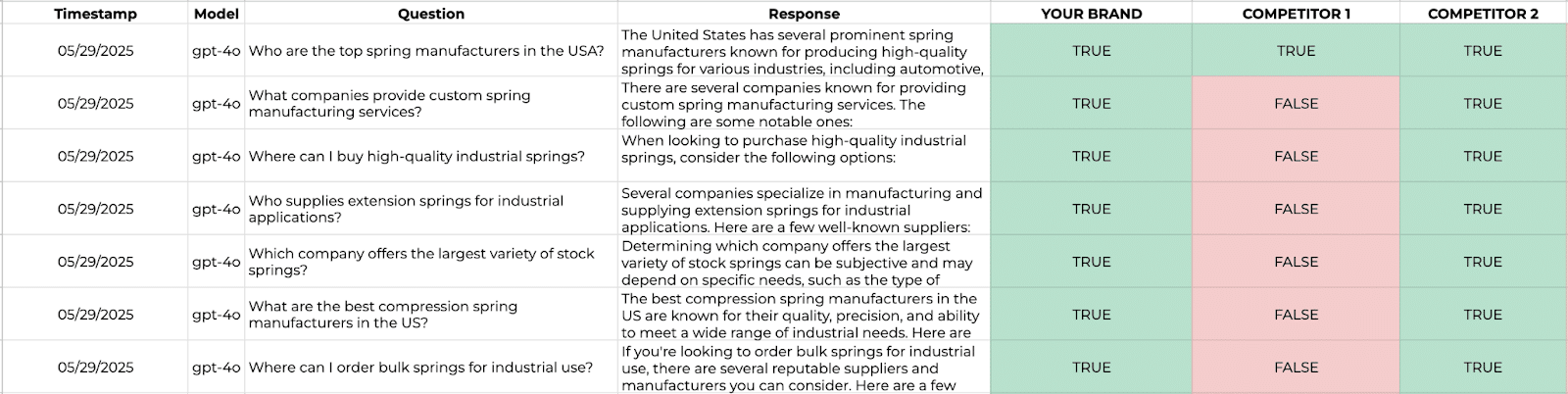
The best tools will track both your brand’s direct visibility (how often you’re referenced in the response) but also your visibility in third-party citations. If a round-up or listicle of the “10 best [your service] providers]” is commonly cited by LLMs, you want to know that so you can invest in getting featured in that piece.
In addition to tracking referral traffic from LLMs, we also recommend keeping an eye on any trends in direct traffic. Some in the field estimate that approximately 20% of direct traffic is actually misattributed traffic from AI tools.
Question: As GEO becomes more central to digital strategy, how should internal teams evolve, and what new skills, roles, or workflows are essential?
Answer:
Since GEO is a content strategy discipline, teams need to strengthen content creation capabilities focused on semantic richness and comprehensive topic coverage and insights from first-hand experience. Teams should also develop skills in using LLMs as market research tools to understand how AI perceives their brand, competitors, customer language, and authoritative sources.
Question: How can brands increase their authority signals in a way that boosts their presence in AI-generated content, and which external platforms or mentions matter most?
Answer:
Use LLMs as intelligence gathering tools to understand how AI perceives your brand and the sources it deems authoritative. Focus on creating authentically helpful, comprehensive content that AI systems recognize as authoritative sources on topics. The key is semantic richness and genuine expertise and mentions in sources cited by AI, rather than traditional authority signals, such as backlinks.
Question: What should companies be doing today to future-proof their content strategies across multiple AI platforms like Google, Bing, and ChatGPT?
Answer:
Focus efforts on optimizing for ChatGPT for now and Google’s AI Mode for the near future. ChatGPT is the primary consumer AI platform currently generating referral traffic, while Google’s AI Mode is expected to become the most significant source of AI-driven traffic given Google’s dominance. We expect Google to switch over to AI mode as their default sometime in the next 9-18 months. However, proven, reliable strategies for generating revenue from GEO are still emerging. Current GEO tactics aren’t as reliable as established SEO playbooks are for traditional search engines.
Question: Does putting LLM instructions into my robots.txt file or using an llms.txt file help me show up in LLM results?
Answer:
No, you don’t need to specify LLM instructions in your robots.txt file—or create a llms.txt file—to get LLMs to crawl your site content.
If anything, the more pervasive problem is LLMs “stealing” content from unwilling publishers, rather than publishers being unable to have their site crawled by LLMs. Any utility of an llms.txt file would be more similar to a sitemap file, meaning it can be used to direct LLMs towards your most valuable content. However, at this point in time, there is limited evidence that creating and maintaining one of these files has any meaningful impact on visibility in LLMs, so we don’t recommend spending time on this at the moment.
Question: Do I do anything differently? (compared to the ‘normal’ digital health SEO playbook)
Answer:
Check out our “The Digital Health GEO Playbook/Checklist (Updated: Summer 2025)”
Question: What’s a good ratio of SEO/GEO inbound traffic/conversions? I suspect most people are seeing very low numbers from GEO and thinking they are doing poorly.
Answer:
Based on the data from digital health websites we have access to, LLM traffic totals are only 0.8% of traditional organic traffic totals. In other words, it is close to inconsequential at the moment. Of course, we don’t expect this to remain the case for long.
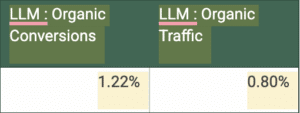
The story with conversions is essentially the same. Our websites see 1.22% as many conversions from LLMs as they do from traditional organic search.
If you’re seeing very low LLM traffic and conversion numbers, don’t fret. That’s likely a consequence of this being a very immature technology with relatively low adoption, rather than you falling behind. Of course, now is the time to get ahead of the curve and position yourself to be a leader in GEO as your ICP continues to adopt generative AI search.
Credits
Author

Noah Goldfarb
Director of Client Services
About the Author
As Fire&Spark’s Director of Client Services, Noah Goldfarb leads the development of data-backed, conversion-focused SEO strategies for our clients. Get in touch with him directly at [email protected]